
Responsible AI use means using AI to work faster and better, while a person stays responsible for what comes out and for what goes in. A language model is a tool that generates text and data, not a party you can hold to account for a mistake. So the question is not whether you use AI, but whether you keep control of the output and of the data you share.
What is responsible AI use?
Responsible AI use means working with AI tools in such a way that the user checks the output, chooses deliberately which data to enter and knows which tasks AI is not suited to. Responsibility lies with the person who publishes the output under their name, not with the model.
In practice, that is exactly where things go wrong. Output that sounds fluent and convincing is accepted as true more quickly than output that looks messy. Working responsibly calls for a fixed attitude: every result is a proposal you check, not an answer you copy.
Why should you always check AI output?
You always check AI output because a model does not tell you when it is wrong. A language model generates the most probable text for a question, and the most probable text is not the same as the correct text. When a model makes up information that sounds convincing, that is called an AI hallucination.
In my own work with Claude, and earlier with ChatGPT, I see the same mistakes keep coming back. Models cite sources and quotations that turn out not to exist when checked. They add figures nobody asked for, such as search volumes, with no source to back them up. And a summary can differ in substance from the original without you noticing, unless you go back to the source.
The framework I use for this comes from my years at major Dutch banks, where the four-eyes principle is standard: important work is checked by a second pair of eyes before it goes out. On the scale of a small office, that becomes a simple agreement. AI makes the draft; a person checks it and carries the responsibility.
Better input makes the checking lighter. If you ask AI a good question and give the model context, you get fewer mistakes back, but that does not remove the checking step itself.
Which data should you not put into an AI tool?
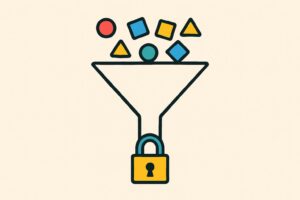
Do not put personal data, medical data, passwords or confidential client or company data into an AI tool without knowing what happens to that data. What you type into a free or personal version can be stored and, depending on the settings, used to improve the model.
If you work with client data, that choice directly touches the GDPR. The rule of thumb is simple: assume that anything you enter can leave the organisation. Business plans usually stipulate that input is not used for training, and where an application processes personal data on a structural basis, it needs a DPIA.
Besides the question of what you enter, there is the quality of what you enter. Outdated or duplicate files produce unreliable output.
When is it better not to use AI?
It is better not to use AI for decisions where a mistake weighs more heavily than the time saved: a final judgement about a person, a legally binding document or a medical assessment. A model can help with the outline, but the decision and the substantive check stay with the professional.
For tasks where AI could be used, the question remains whether it is needed. For a short factual question with one clear answer, a search engine or the official source is often faster and more reliable. AI is at its strongest in work that needs structure, a first draft or an analysis of a lot of text.
The trade-off differs from case to case, but the guiding principle stays the same. Use AI where it saves time without putting quality or confidentiality at risk, and deliberately choose another route where it would.
What belongs in an AI policy for your organisation?
An AI policy for your organisation sets out which tools are allowed, which data may go into them, where the checkpoint is and who keeps the policy up to date. Without those agreements, every employee decides for themselves what is and is not acceptable, resulting in uneven quality and risks nobody has a clear view of.
Five elements make an AI policy workable:
- Permitted tools, preferably with business accounts whose terms are known.
- A data boundary that states, for each type of data, what may and may not go into a tool.
- Tasks AI is used for, and tasks it is not used for.
- A checkpoint before output goes to a client or outside the organisation.
- An owner who keeps the policy current, because tools and rules change quickly.
Such a policy does not need to be long, but it must be known and supported. Where it is missing, shadow AI appears: employees choose their own tools because the official route is missing or too slow.
An AI policy also supports the obligation in Article 4 of the AI Act. Organisations that deploy AI systems take measures that support their employees’ AI literacy, worded since 27 July 2026 as an obligation of effort. A policy on paper is not enough for that. AI training for teams makes sure the team uses the same way of working and the same checking steps, and the AI Literacy Course lays the foundation for each employee, with a certificate on completion. For a first foundation in about two hours, there is AI Literacy Essentials.
How does responsible AI use differ by profession?
To see how responsible AI use differs by profession, look at what is at stake if something goes wrong and which supervision applies. The technology is the same everywhere, but in regulated professions checking is not a choice but a professional duty.
Legal professions
Legal professions are subject to disciplinary law, which makes responsible AI use directly testable there. The professional remains liable for every document, even when a model produced the draft. In the Netherlands, the Netherlands Bar (Nederlandse orde van advocaten, NOvA) published recommendations in December 2025 that make the core values of the legal profession the test. For AI among Dutch civil-law notaries, the AI-weegschaal from the Royal Dutch Association of Civil-law Notaries (KNB) offers an assessment framework that helps decide where AI can and cannot be used responsibly.
Accountancy
Accountancy combines figures with confidential client data, so a mistake in a report or tax return has direct consequences. The duty of confidentiality and the requirements for professional competence call for demonstrable care, and in that profession the four-eyes principle is not an extra step but a matter of course.
Marketing agencies
For marketing agencies, the main risk comes from volume. AI produces a lot of content quickly, but text nobody checks undermines the credibility of the agency and of the client. The responsibility for checking output for facts and origin stays with the person who creates it.
Responsible AI use only becomes a fixed way of working when policy, tool choice and checkpoints are set down together. In the AI Literacy Course you learn to set down those three in an internal AI policy, and with AI literacy for teams your whole team takes the same course.
Frequently asked questions about responsible AI use
Responsible AI use also touches on transparency towards readers and on the broader term responsible AI.
Do you have to disclose that a text was made with AI?
Since 2 August 2026, disclosing that a text was made with AI has been mandatory when you publish that text to inform the public on matters of public interest. Article 50 of the AI Act makes an exception if a person has reviewed or edited the text and someone holds editorial responsibility for the publication. For deepfakes, meaning AI-generated images or audio that look or sound real, the disclosure obligation applies without that exception.
What is the difference between responsible AI and responsible AI use?
Responsible AI is mainly about how organisations and governments develop and deploy AI systems, while responsible AI use is about your daily work with those tools. The OECD AI Principles from 2019, updated in May 2024, name values such as transparency and accountability for this. For people who use AI tools, those values come down to checking what comes out and choosing deliberately what goes in.