AI training for employees and teams
AI training for businesses from five employees, for organisations where staff already use AI without agreed rules. Each employee takes the courses online at their own pace, with their own account and a certificate in their own name.
- From 5employees
- Onlineat your own pace
- 12 monthsno automatic renewal
- By invoiceper organisation
Office licence per employee per year
- 5 to 9 employees
- €169.99
- 10 to 24 employees
- €149.99
- 25 to 49 employees
- €129.99
- 50 or more
- price per organisation
All amounts include VAT, per employee per year, paid by invoice after a quote. Minimum of five employees.
Three forms of AI training for businesses
LearnLLM offers AI training for businesses in three forms, all online and per employee: the office licence for all four courses, AI Literacy for teams and the short AI Literacy Essentials for teams. The difference lies in how broadly your team learns to work with AI.
The choice comes down to one question. Does everyone need the same foundation to use AI responsibly, or do you want the team to also learn to work with ChatGPT, Claude and automation? The first is AI literacy, the second is the office licence. For AI training in organisations with several teams, you order the form that fits each team.
Office licence for your whole team
The office licence gives each employee one year of access to the four paid courses, with a certificate for each completed course. The licence starts at five employees: you request a quote, pay by invoice, and we set up an account for every employee.
Employees work through the courses at their own pace, eight to eleven hours per course. You lose no staffing for a day, because there is no moment when the whole team has to be free at the same time. New employees who join during the year get a free seat or take over the seat of a colleague who leaves.
This form suits an organisation where AI is already in use without agreed rules. Employees who pick their own tools outside the policy rarely do so out of unwillingness, but because the official route is slower or does not exist yet. Company AI training solves the knowledge side of that: everyone knows what the tool does and where its output is convincingly wrong. You record the rules themselves in an internal AI policy, and the AI Literacy course covers how to draw one up.
For teams from five employees
Every employee gets their own account and a certificate in their own name, with a price per seat per year and payment on invoice. We set up your team for you: tell us how many employees and which course, and you receive a quote within two working days.
AI Literacy for teams
AI Literacy for teams gives each employee one year of access to the eight-hour AI Literacy course, with practical assignments, a final test and a certificate in their own name. This form fits when everyone needs the same foundation: how AI works, where it goes wrong, which data you never enter and which agreements you put in writing.
For teams from five employees
Every employee gets their own account and a certificate in their own name, with a price per seat per year and payment on invoice. We set up your team for you: tell us how many employees and which course, and you receive a quote within two working days.
AI Literacy Essentials for teams
The Essentials version takes about two hours and gives the whole team a shared start, with knowledge checks and a certificate. Choose AI Literacy Essentials for teams if you want to give everyone the same foundation quickly and follow up with more depth later.
What your team learns from AI training
What your team learns from AI training is twofold for each employee: the skill to use an AI tool professionally, and the habit of checking the output before it goes to a client. The courses are built around the second, because that is where the risk to an organisation lies.
In my work as an SEO specialist working with AI content, I see the difference between the two daily. Someone who masters a tool delivers a first draft faster. Someone who checks the output delivers a version that is ready to send out.
The courses in the office licence
The licence includes four paid courses: AI Literacy, ChatGPT, Claude and AI Automation. Each course takes eight to eleven hours and ends with a final assignment and a certificate; AI Literacy also includes a final test. So an AI course for businesses here is not a loose series of videos, but a route per employee with a finished result.
The AI Literacy course covers what AI does and does not do, which risks come with using it, and what Article 4 of the EU AI Act asks of an organisation. The ChatGPT and Claude courses are built per tool, because the two respond differently to the same instruction, and an employee who does not know that picks the wrong tool for the wrong task. The AI Automation Course is for teams that want to build AI into their own workflow instead of a chat window, which makes it the advanced part of the range.
What AI training gives employees differs per role. A marketer gets the most out of the Claude Course, a controller starts with AI Literacy, and within the same licence everyone chooses their own route. That is why AI training for teams works better than one mandatory course for the whole organisation.
What stays after the training
After AI training for employees, your team keeps three things: a repeatable way of working for each core task, prompt examples that fit their own work, and a clear view of which tasks need a human check. You then record the checkpoints for your organisation in an internal AI policy, and the AI Literacy course covers how to draw one up.
I moved from one-off prompts to fixed workflows myself when I saw errors ending up in production. One-off prompt tips work as long as one person uses them and remembers where the pitfalls are. With identical prompts, the same model produces varying output, and clients do not accept varying output. That unpredictability forced me to build fixed ways of working instead of writing better prompts.
From my years at major banks, I bring the four-eyes principle to AI work. Not every task has the same risk profile, so not every task needs the same check. An internal note and a document that goes to a client under your organisation's name deserve different checkpoints. Making that distinction explicit is the difference between a team that uses AI and a team that uses AI responsibly.
AI Literacy course
What AI does and does not do, which risks come with using it, and what Article 4 of the AI Act asks of an organisation.
View the AI Literacy course
ChatGPT Course
From one-off prompts to repeatable workflows in ChatGPT, with the checkpoints that decide when a person reviews the output.
View the ChatGPT Course
Claude Course
Working with long documents and tasks where instructions must be followed precisely, including the differences from ChatGPT.
View the Claude Course
AI Automation Course
For teams that build AI into their own workflow instead of a chat window. No code up to and including module 4; in module 5, only the Python assignment is optional.
View the AI Automation CourseWhat the EU AI Act asks of your business
What the AI Act asks of your business is set out in Article 4: every organisation that uses AI must take measures that support the AI literacy of its staff. AI training for businesses is one of those measures, but the regulation does not prescribe a form.
There is no required number of hours, no required exam and no required certificate. A training provider that says its training is required by law is claiming more than the text allows.
What Article 4 requires of your organisation
Article 4 of the AI Act has applied since 2 February 2025. The original text referred to measures that ensure a sufficient level of AI literacy. Regulation (EU) 2026/1744, the Digital Omnibus on AI, replaced that wording as of 27 July 2026: the obligation is now to support the development of AI literacy, with the explicit addition that an organisation does not have to guarantee a particular level for each employee.
Article 99 does not list Article 4 in the penalty categories of paragraphs 3 to 5. Paragraph 1 does let member states lay down their own penalties for infringements of the regulation, and according to the European Commission, national supervisory authorities enforce Article 4 on the basis of national law. Since 2 August 2026, the transparency obligations of Article 50 also apply, and those do fall under Article 99(4).
In the Netherlands, the Dutch AI Act Implementation Act (Uitvoeringswet AI-verordening) is not yet law. The public online consultation ran from 20 April to 1 June 2026, and the bill gives the coordinating role jointly to the Dutch Data Protection Authority (Autoriteit Persoonsgegevens, AP) and the Dutch Authority for Digital Infrastructure (Rijksinspectie Digitale Infrastructuur), with the AP as the fallback supervisor for high-risk AI that has no supervisory authority of its own. Until that act enters into force, the Netherlands has no instruments of its own for fines and enforcement, while the regulation itself applies directly.
How to show AI literacy for each employee
Being able to show it takes a file, not just a certificate. What you want to be able to show is which employee took which AI training, when, which topics it covered, and which agreements on AI use apply within your organisation. The regulation states explicitly that the required level differs per role: someone who uses a chatbot for draft texts needs a different level from someone who manages a system that makes decisions about people.
The team products provide the first part: a certificate per employee for each completed course, with a date and verification code, and a learning record with the learning objectives and the study load. The second part is the internal AI policy that sets out what is and is not allowed, and your organisation adopts that policy itself. If you want the policy drawn up for you, you can ask for a tailored AI policy via the contact page. Both are evidence, not a guarantee, because compliance remains your organisation's responsibility.
What the office licence includes
The office licence for AI training for businesses has six parts: the courses, a certificate per employee, access for new colleagues, prompt examples per core task, the annual update, and the fact that access belongs to the organisation and not to the person. The last three are why an annual licence is different from buying courses per person.
Access to all courses
Each employee gets one year of access to the ChatGPT, Claude, AI Automation and AI Literacy courses, to work through at their own pace.
Included in the licenceEvidence for the personnel file
A certificate shows who completed which course and when, and can be checked online with the verification code. It is not a guarantee of compliance with the AI Act.
Included in the licenceAccess for new colleagues
With individual courses, each new colleague starts from zero and access leaves with the employee who bought it. Within the licence, a seat moves on to the next person.
Annual licence onlyPrompt examples per core task
Each course provides prompt examples per core task that an employee can adopt straight away.
Included in the licenceOne account per work email address
Each account is in the employee's name and on their own work address, because a certificate tied to a shared login says nothing about who actually took the course.
Included in the licenceAnnual update
The courses are updated every year when models change, because the same prompt can give a different result on a new version.
Annual licence onlyThis is what it looks like for an employee: their own account with the courses and the progress per course, and a certificate in their name once they finish.
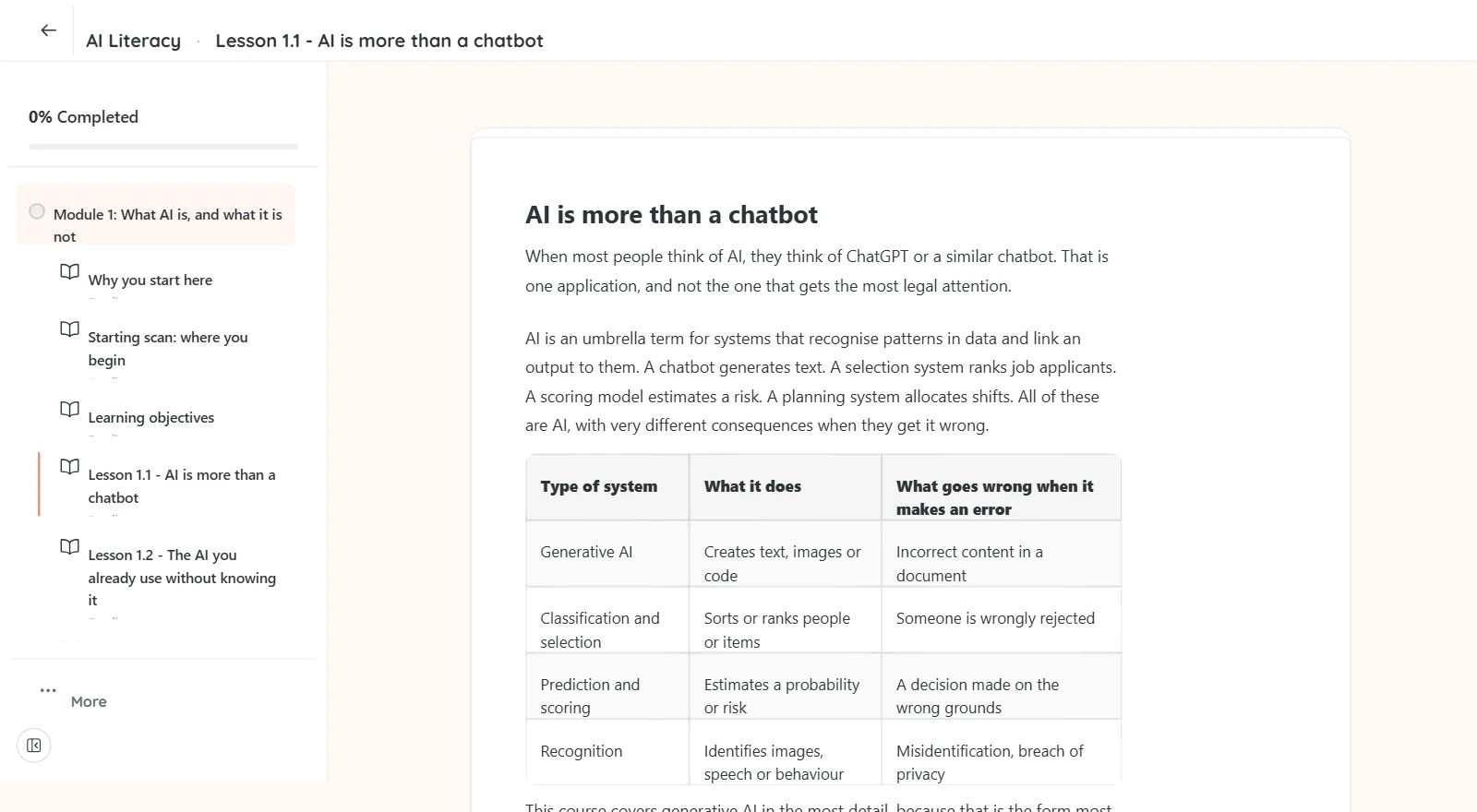
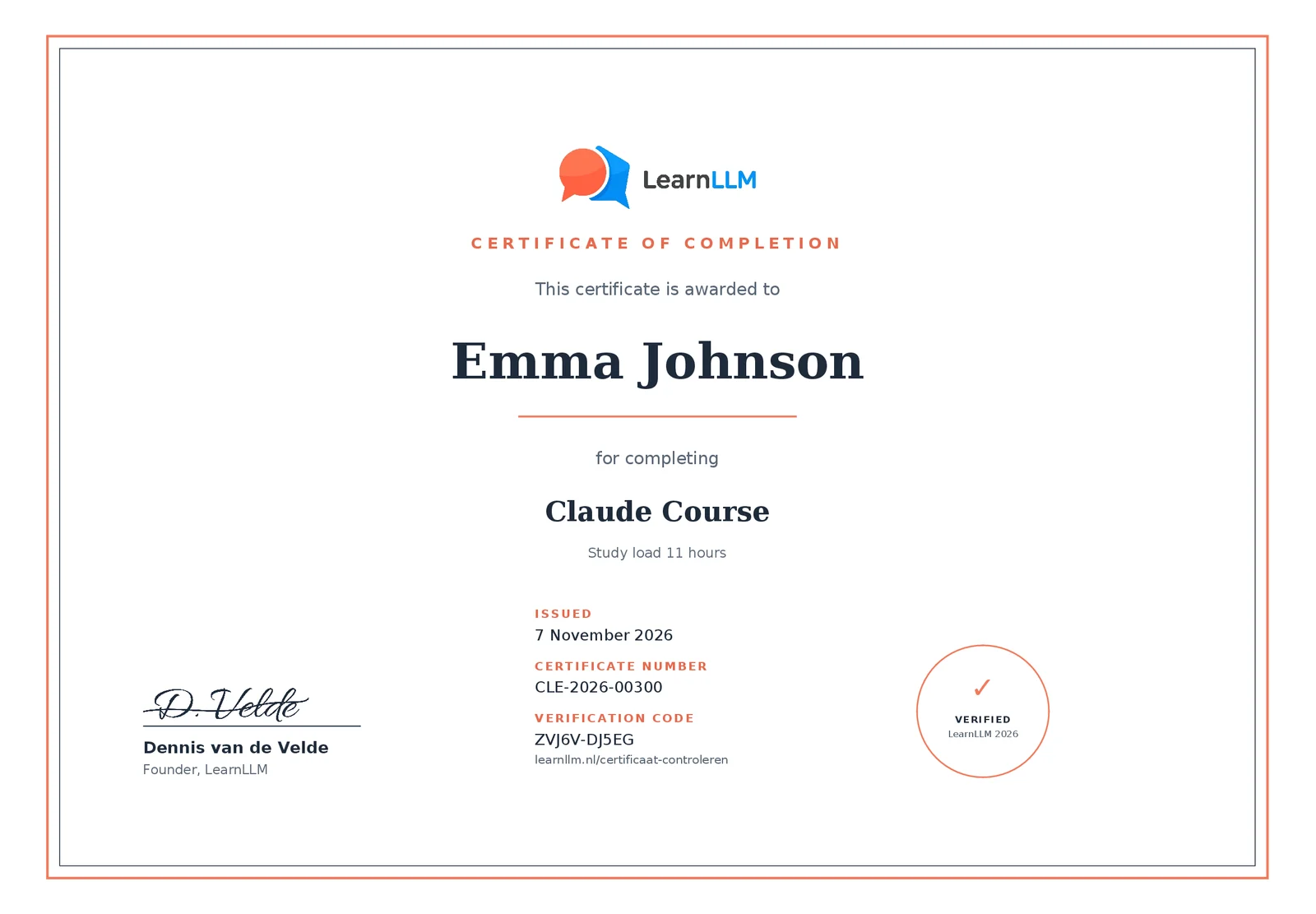
Tap an image to view it at full size.
How AI training for your team works
AI training for your team runs in four steps, from the quote to the file. There is no set lead time, because employees decide for themselves when they work through the courses. The fourth step turns training into evidence, and in this market it is the step that is least often worked out.
Request a quote
Tell us via the contact page how many employees and which product you want, and you receive a quote within two working days at the price for your band. You pay by invoice, in your organisation's name.
Work email as login
You send us each employee's name and work email address, and we set up an account for every employee. Each account is in the employee's name, because each certificate must be traceable to one employee. With shared logins, the file is worthless.
Work through the courses
Each employee chooses their own moments, eight to eleven hours per course, and finishes with a final assignment in which they record their own way of working. In AI Literacy, a final test also assesses their knowledge.
Keep a record you can show
Showing AI literacy takes more than a certificate: who, when, which topics were covered, and which AI agreements apply in your organisation. The licence provides the first three; you record the agreements in your organisation's internal AI policy.
What AI training for businesses costs
What AI training for businesses costs depends on the form and the number of employees. All team products are charged per employee per year, including VAT, and these are the prices on your quote.
Office licence per employee per year
The office licence costs €169.99 per employee per year for five to nine employees, €149.99 for ten to twenty-four and €129.99 for twenty-five to forty-nine. From fifty employees, the price is on request, and the minimum is five employees.
For a team of fifteen, that comes to €2,249.85 per year for access to all four courses. From two courses per employee, the licence costs less than buying the same courses individually, in every band of the volume pricing.
Only AI literacy for the whole team
If your team mainly needs the same foundation in AI literacy, AI Literacy for teams is the lighter alternative: only that course, for €124.99 per employee per year for five to nine employees, €109.99 for ten to twenty-four and €99.99 for twenty-five to forty-nine. You request it the same way as the licence, through a quote. If you want the team to also learn to work with ChatGPT, Claude or AI automation, the licence is the better choice at €30 to €45 more per employee.
For a short shared start, AI Literacy Essentials for teams costs €49.99 per employee per year for five to nine employees, €44.99 for ten to twenty-four and €39.99 for twenty-five to forty-nine.
| Form | Basis | Price |
|---|---|---|
| Office licence, 5 to 9 employees | per employee per year | €169.99 incl. VAT |
| Office licence, 10 to 24 employees | per employee per year | €149.99 incl. VAT |
| Office licence, 25 to 49 employees | per employee per year | €129.99 incl. VAT |
| Office licence, 50 or more | per organisation | on request |
| AI Literacy for teams, 5 to 49 employees | per employee per year | €124.99 to €99.99 incl. VAT |
| AI Literacy Essentials for teams, 5 to 49 employees | per employee per year | €49.99 to €39.99 incl. VAT |
Frequently asked questions about AI training for businesses
Answers on price, form, time and Article 4, including the forms LearnLLM does not offer and the reason why.
What does AI training for businesses cost?
At LearnLLM, AI training for businesses is priced per employee per year, and the larger the team, the lower the price per employee. The office licence with all four courses starts at €169.99 and goes down to €129.99 including VAT; AI Literacy for teams starts at €124.99 and the Essentials version for teams at €49.99.
The full volume pricing per form is listed under what AI training for businesses costs. You pay for the licence by invoice, in your organisation's name.
Do you also offer an AI workshop or on-site training?
LearnLLM does not run AI workshops for businesses or on-site AI training, and will not add them. The range is built on what the team keeps using after the training, and a single day with a trainer does not deliver that.
What is available for a whole team: the office licence and AI Literacy for teams, with which employees work through the courses online at their own pace, with a certificate per employee.
How much time does AI training take per employee?
AI training takes an employee eight to eleven hours per course, including practical assignments based on their own work, spread over moments they choose themselves. For one course, that is more than a working day per person, but never for the whole team on the same day.
With a classroom day, the whole team is unavailable at once, including the people who already know the material. With self-study, that time shifts to the hours each employee has available.
What does this AI training provide for Article 4 of the EU AI Act?
For Article 4 of the EU AI Act, this AI training provides evidence of a measure taken: for each employee, a certificate with a date and verification code and a learning record with the learning objectives and the study load. No provider can guarantee compliance, because compliance remains your organisation's responsibility.
Since its amendment by Regulation (EU) 2026/1744, Article 4 asks for measures that support the development of AI literacy, without a prescribed form, duration or certificate, and without a particular level having to be ensured for each employee. Showing compliance is therefore a matter of keeping a file: who took what, when, and which agreements apply in your organisation.
Does my team need any technical knowledge?
None of the four courses requires technical knowledge. All four assume an employee who works with a browser and Office.
The AI Automation Course is the only one that goes in a technical direction. Up to and including module 4 you build without code, using Zapier or Make; in module 5, only the Python assignment is optional, while the lessons and the knowledge check of that module count towards the certificate. Within the licence, each employee chooses which courses to take.
What is the minimum number of employees for an office licence?
An office licence starts at five employees. For five up to and including 49 employees, you request a quote with the number of employees, and the price per employee for that band applies to the whole team. For fifty or more employees, you request a price per organisation via the contact page.
Below five employees, each person buys the course individually, with twelve months of access and their own account on their own work address. That way, each certificate stays traceable to the employee who took the course.
What happens with new employees who join later?
New employees get a free seat within the licence, or take over the seat of a colleague who leaves. For an organisation with staff turnover, that is the main reason to take a licence instead of buying courses per person.
An individual course belongs to the employee who bought it, so access leaves with that employee and a new colleague starts from zero. Within the licence, you can transfer as many seats per year as you bought.
Which AI tool should I choose for my team's training?
Which AI tool you choose for your team's training, ChatGPT or Claude, depends on the work, and the office licence includes both courses, so you do not have to decide in advance. ChatGPT training for businesses suits teams that already work in the OpenAI ecosystem.
Claude is the obvious choice for work with long documents and for tasks where instructions must be followed precisely. In my own work I use Claude daily, and I used ChatGPT intensively during the period when I built custom GPTs with it for my SEO work. The two respond differently to the same instruction, and knowing that difference is more useful than declaring one of them the standard.