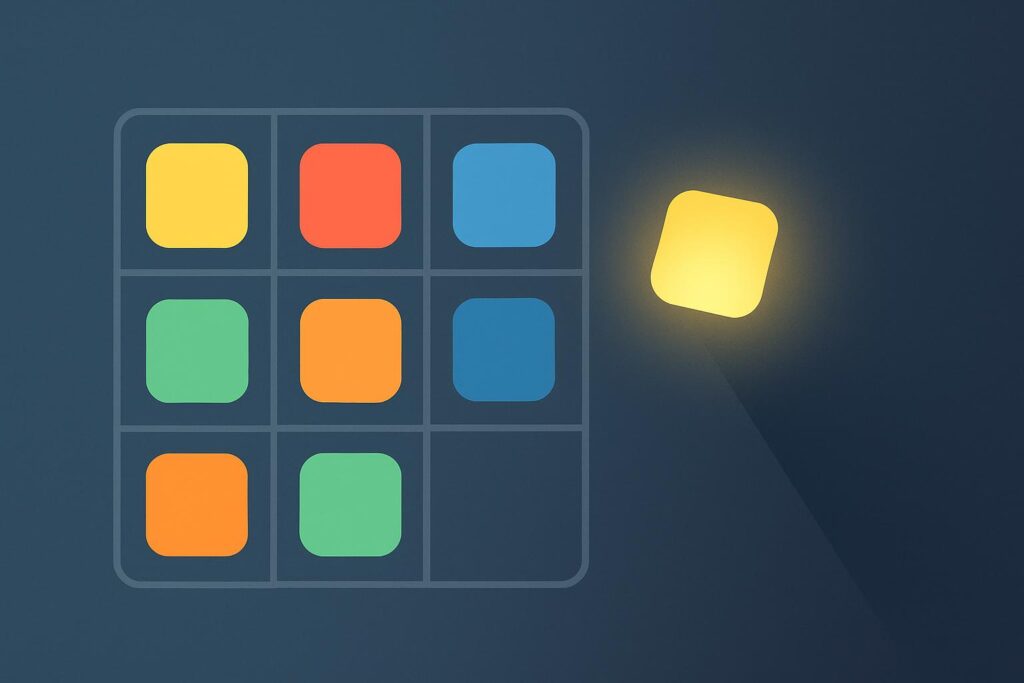
Shadow AI is the use of AI tools by employees without the permission or knowledge of the organisation. An employee pastes a client file into a free chatbot to have it summarised, for example: the tool is not on any approved list, nobody has oversight of it and the data leaves the office unnoticed.
The behaviour is almost always well-intentioned. Employees want to work faster and reach for a tool that delivers a result within thirty seconds. The problem is not the intention but the lack of visibility and agreements.
What is shadow AI?
Shadow AI is any use of artificial intelligence at work that falls outside the organisation’s view and agreements. Think of a personal ChatGPT account for drafting client emails, a free translation tool for a contract or a browser extension that summarises meetings.
Three features make AI use shadow AI. The organisation has not approved the tool, there is no agreement on which data may go into it, and nobody knows where the information ends up afterwards. If you use an approved tool but enter data that the policy does not allow, you run the same risk, although strictly speaking that counts as poor compliance.
What is the difference between shadow AI and shadow IT?
The difference between shadow AI and shadow IT is that shadow AI is a specific form of the broader shadow IT. Shadow IT means employees use software, apps or cloud services the organisation has not approved; shadow AI is limited to tools that run on artificial intelligence.
Classic examples of shadow IT are everyday ones: a personal Dropbox to share work files with a client, a free online tool that converts a PDF, a WhatsApp group with clients because it feels quicker than official email. An AI chatbot that summarises a report belongs on the same list, but it brings an extra risk.
An unauthorised file service stores data; an AI tool processes it and turns it into new output. Depending on the account and the settings, the input may be stored and used to improve the model. On top of the data risk comes the output risk: a model can make up facts that end up in client work unnoticed. That makes shadow AI the most acute form of shadow IT at work.
How does shadow AI arise?
To understand how it arises, look at the work rather than the employee. It rarely comes from unwillingness: people feel time pressure, see a tool that speeds up their work and use it without stopping to think that there is no policy for it.
Three factors reinforce each other. Most AI tools are free and work straight in the browser, with no installation or request needed. There is often no approved alternative, so employees find one themselves. And many organisations are still shaping their AI policy while employees have already gone ahead. AI training for employees takes the pressure off, because everyone learns which tools and which data are allowed.
Shadow AI is therefore a structural gap rather than a discipline problem. If you treat it as disobedience, you tackle the wrong cause; the real question is why the approved route was missing.
What are the risks of shadow AI?
The risks of shadow AI come down to one principle: you cannot protect what you cannot see. The Oh, Behave! study (2024) by CybSafe and the US National Cybersecurity Alliance found that 38% of working people who use AI share sensitive work information with AI tools without their employer knowing.
Data breaches
Data breaches through shadow AI happen the moment an employee pastes client data, annual figures or a strategy document into an uncontrolled tool. The organisation then does not know where the file is, who can access it or whether it is being stored. You cannot contain an incident in a tool you did not know existed.
GDPR
The GDPR comes into play as soon as personal data ends up in a tool for which no data processing agreement is in place. Without visibility of where the data is processed and stored, the organisation cannot meet its accountability obligation. Where an AI application processes personal data on a structural basis, a DPIA is needed, and you can only carry one out for a tool you know about.
Professional secrecy
Professional secrecy makes shadow AI more serious for accountants, notaries and lawyers than for other sectors. They work under a statutory duty of confidentiality and are subject to disciplinary law. In AI for accountants the issue is client files and tax data; in AI for lawyers it is court documents and client information covered by the core value of confidentiality.
Liability
Liability for AI output always lies with the professional. The principle is simple: AI is never responsible, you are. Drawing on my years at major banks, I translate compliance into three questions: which data may go into an AI tool, which claims can you justify, and who is liable for the output? With shadow AI, the answer to all three is unclear.
Why does an AI ban not solve shadow AI?
An AI ban does not solve shadow AI, because the use moves to personal accounts and personal phones where there is no visibility at all. The need that made employees use the tools in the first place remains.
A ban also signals that the organisation is not keeping up, while clients and colleagues increasingly expect AI. On top of that, Article 4 of the AI Act asks organisations that deploy AI systems to take measures that support their employees’ AI literacy, worded since 27 July 2026 as a best-efforts obligation. If you ban everything, you do not build that literacy. The alternative is responsible AI use within clear boundaries.
How do you map shadow AI?
To map shadow AI, ask employees, without sanctions, which AI tools they use, for which tasks and with which data. An anonymous or sanction-free inventory almost always produces a longer list than management expects.
Record the outcome in an AI register: a simple overview per tool with its purpose, the type of account (personal, free or business), the data that goes into it and the employees who use the tool. This shows, per employee, which tasks are already done with AI and, per tool, which data leaves the organisation.
The register makes the difference in risk per task visible. Having an internal note rewritten is not the same as running a complete client file through an external tool, and the level of control should scale with that risk.
How do you get shadow AI under control?
To get shadow AI under control, give employees an approved alternative that is easier than the tool they are now using on the quiet. Control comes from a legitimate route, not from a closed door.
Three components form the basis. An AI policy sets out which tools are allowed, which data may go into them and who is the point of contact for new tools. An approved toolset with business accounts ensures that input is covered by agreements. And AI literacy helps employees understand why the line is drawn where it is.
A ban pushes use to personal accounts; an easier approved route brings it into view.
For output that goes to a client, I apply the four-eyes principle from banking practice: nothing is sent without a second look. For an office without an IT department, an internal point of contact and a short policy document work better than detection software that assumes a security team. In the AI Literacy Course you learn to set out that policy, the permitted tools and the checkpoints; for teams of 5 employees or more, every employee gets their own account.
Shadow AI does not disappear with stricter monitoring but with a shared way of working the team can sustain. With AI literacy for teams, everyone learns the same agreements on tools and data.
Frequently asked questions about shadow AI
Shadow AI also raises questions about related terms and about what to do if something has already gone wrong.
What is the difference between shadow AI and BYOAI?
The difference between shadow AI and BYOAI is that BYOAI, bring your own AI, only describes employees bringing their own AI tools to work. Microsoft used the term in its Work Trend Index of May 2024, in which 78% of AI users among 31,000 knowledge workers said they did this. Shadow AI puts the emphasis on the lack of approval and visibility. Your own tool that the organisation knows about and allows is BYOAI without being shadow AI.
Can you detect shadow AI technically?
Yes, you can partly detect shadow AI technically with software that maps the use of cloud apps in your organisation. According to Microsoft, Microsoft Defender for Cloud Apps has a separate category for generative AI with more than a thousand apps, with a risk assessment for each app and the option to allow or block it. Software like this only sees devices and connections the organisation manages. A personal phone stays out of view, so an inventory among employees is still needed.
Do you have to report a data breach caused by shadow AI?
You must report a data breach caused by shadow AI to your data protection authority (in the Netherlands, the Dutch Data Protection Authority, Autoriteit Persoonsgegevens, AP) if personal data is involved and the breach is likely to pose a risk to the people concerned. The GDPR requires you to do so without undue delay and no later than 72 hours after you become aware of the breach. If the risk is high, you also inform the people concerned themselves. If it is unclear where the data that was entered has ended up, that risk is hard to rule out.