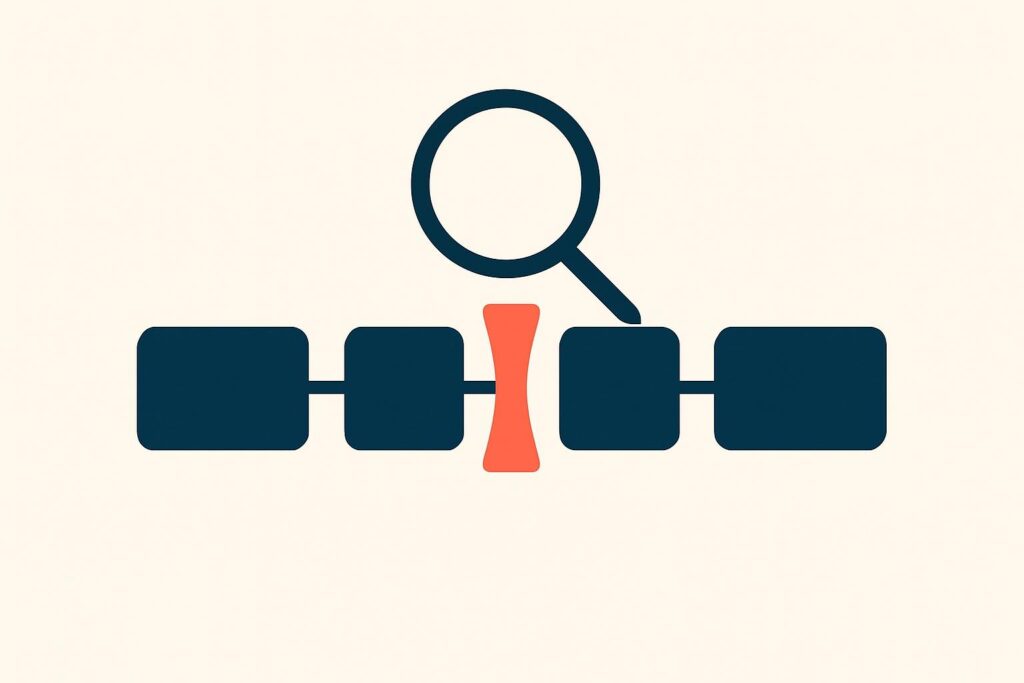
AI process optimization means making a work process faster and more reliable by first finding the bottleneck and only then using AI there. Most organisations do it the other way round: they apply AI to the task that is easiest to speed up and then find that the process as a whole hardly runs any faster.
The difference between optimising and automating determines where you start. Research into AI at work shows why time saved per task so often evaporates in the next step, and which steps do and do not belong with AI.
After that, you will find a five-step approach, the risks that come with AI in a work process and what the bottleneck looks like in a notary’s office, an accountancy firm and a marketing agency. The focus is on knowledge work in offices. Process optimization in manufacturing and logistics, such as predictive maintenance of machines, is a different field with its own techniques.
What is AI process optimization?
AI process optimization means improving a work process by finding the bottleneck in the chain and having AI support or take over a well-defined step there, with a person checking the outcome.
The process is at the centre, not the technology. AI is one of the means of improving a process, alongside a clear agreement on who does what, a different order or a fixed rule in the software. Sometimes the best optimisation is one without AI.
What is the difference between optimising and automating?
The difference between optimising and automating is that optimising redesigns the process itself, while automating means an existing step is carried out without a person. Optimising is about the order, the responsibility and the quality of the input. Automating is about one step that then always runs the same way.
Optimising comes first. A process with unclear input or a review round without an owner does not get better through automation; it just gets stuck faster. Within automation itself there is a second distinction: the difference between AI and automation determines whether a step needs a language model or a fixed rule.
Why does time saved per task do so little for the process?
Time saved per task does little for the process because the work then waits for the next step: a review, a check or someone who needs to follow up. A draft that is ready in ten minutes instead of an hour then sits on a desk for just as long.
Only the step that holds up the work determines how fast the process runs.
Research confirms that pattern. In a controlled experiment with 453 professionals, Noy and Zhang (Science, 2023) found that participants needed 40% less time and delivered 18% higher quality on short, well-defined writing tasks of 20 to 30 minutes. At the level of an organisation, little of that remains.
In a survey of 25,000 workers in eleven occupations in Denmark, participants reported saving 2.8% of their working time, roughly an hour a week (Humlum and Vestergaard, 2025). In the administrative data on the same group, the researchers found no measurable effect on wages or hours worked.
Executives see the same thing. In a survey in four countries, 89% of executives said they had seen no effect of AI on labour productivity over the past three years (Yotzov et al., NBER, 2026). If you put working smarter with AI into practice as an individual, you save time for yourself; for the office, what counts is the step that holds up the work.
Which process steps are suited to AI?
Process steps are suited to AI when they fall within the limits of what a language model does reliably. Research has made that boundary visible. In a field experiment with 758 BCG consultants, participants worked 25.1% faster with AI, but only on the 18 tasks that fell within that boundary (Dell’Acqua et al., Organization Science, 2026).
On one task deliberately chosen to fall outside the boundary, the same consultants using AI reached the correct answer 19 percentage points less often. So the question for each process step is not whether AI can do it, but whether the step falls inside or outside that boundary.
In which steps does AI save time?
AI saves time in process steps where a lot of text or variation comes in and the outcome is quick to check. Four steps keep coming up in offices:
- Extracting and organising incoming documents that each sender formats differently.
- Summarising long documents in a fixed structure for the specialist.
- Writing first drafts of standard correspondence that an employee then edits.
- Categorising incoming questions or email by topic and urgency.
Each of these steps needs digital input that is complete and consistent. Missing fields or duplicate files make the outcome unusable, which is why AI data readiness belongs in the assessment of a step, not after the first failed trial.
In which steps does the decision stay with a person?
The decision stays with a person in every process step that involves professional judgement, exceptions that differ case by case or consequences for a client. There, the task falls outside the boundary within which AI works reliably.
In practice, calculations are also among the steps you should not leave to a language model. On zzpgeldzaken.nl, the database I had set up with AI contained many errors, so calculations and comparisons on the site were wrong. Text is much easier to automate than formulas.
Sometimes the reason to keep a step manual is that the model does not have the information. Keyword research is the one step I deliberately do not automate: a model has no data on what people actually search for; that information sits in search volume data.
How do you get started with AI process optimization?
To get started with AI process optimization, choose one process and first look for the step where the work gets stuck. Five steps, in this order:
- Find the step where work waits, such as a review round or an inbox that keeps filling up.
- Measure how often the process occurs, how long it takes and how often something is corrected.
- Choose the smallest intervention that solves the bottleneck: a team agreement, a fixed rule or AI.
- Test the intervention on a small set of real cases before the whole process switches over.
- Compare the outcome with the baseline measurement, then look for the next bottleneck in the chain.
That order comes from my own work. My first content pipeline wrote and published fully automatically, and the quality was poor. The solution was not a better model but a different division of labour within the process: I now write with Claude and read every text myself; only the publishing is still automatic.
Many organisations skip step 4. In my experience, a test run on a small sample before bulk processing starts catches most problems, at a point when they still cost nothing.
What risks come with AI in a work process?
Three risks come with AI in a work process: an error that slips through unnoticed, data that is processed incorrectly and responsibility that becomes unclear.
An error slips through when a step falls outside the limits of AI and nobody checks the outcome. One of the places I worked at the bank was the fraud department, where everything ran on the four-eyes principle. In a process with AI, that principle translates into a fixed check on deviations and borderline cases.
Personal data may only pass through an AI step with a legal basis and a data processing agreement. Accounts in the organisation’s name and a business plan with the model provider are the foundation for that.
Responsibility for the outcome stays with the professional, not with the tool. In addition, Article 4 of the EU AI Act has applied since 2 February 2025. Since 27 July 2026 (Regulation (EU) 2026/1744), it has asked organisations to take measures that support the development of their employees’ AI literacy, without requiring them to ensure a particular level for each employee.
What does AI process optimization look like by sector?
AI process optimization looks different in each sector, because the bottleneck and the limits of professional judgement differ by profession.
How does a notary’s office optimise processes with AI?
A notary’s office optimises processes with AI mainly around incoming documents and building the case file, such as a purchase agreement that arrives by email from the estate agent and is added to the file by hand. Assessing the deed stays with the notary, and many case management systems are closed, which determines which step can be connected. What applies to AI for legal professionals, where it strengthens the work and where the limit lies, largely applies to notaries too.
How does an accountancy firm optimise processes with AI?
An accountancy firm optimises processes with AI mainly in how clients supply information: sorting client documents, extracting data and asking for what is missing. The judgement behind an opinion stays with the accountant. For AI for accountants in the Netherlands, the NVKM also matters. This Dutch quality management standard for accountancy firms will also apply to the remaining firms with assurance or compilation engagements from 1 January 2027, and it requires demonstrable control measures.
How does a marketing agency optimise processes with AI?
A marketing agency often optimises processes with AI beyond production, because writing is already faster and the bottleneck shifts to review and reporting. Client reports are a clear example. For learnllm.nl, zzpgeldzaken.nl and the client sites I manage at Space’M Online, I set up BigQuery as a central collection point, so that an analysis question no longer means exporting and pasting.
When should you have a process automated?
You have a process automated when AI process optimization has shown that one step runs the same way every time, the input arrives digitally, the source system has an API or export, and the step requires no professional judgement. If a step meets those conditions, the next question is who builds it and how the check is built in.
LearnLLM builds such automations for well-defined work processes. If you want to build it yourself, the AI Automation Course has you set up one process with a checking step, either without code via Make or Zapier, or with Python. That way, the time AI saves on a task also speeds up the process.
Frequently asked questions about AI process optimization
AI process optimization brings up related terms that mean something slightly different.
What is process mining?
Process mining is a technique that reconstructs how a process actually runs from the event logs of your systems, such as the timestamps in a CRM or case management system. In 2011, the IEEE Task Force on Process Mining described its aim as discovering, monitoring and improving real processes using knowledge from those logs. For AI process optimization, process mining gives a factual picture of where work waits, instead of an estimate.
What is the difference between AI process optimization and RPA?
The difference between AI process optimization and RPA is that RPA automates an existing action, while process optimization first determines which step needs improving. RPA (robotic process automation) uses software robots that carry out repetitive tasks according to fixed rules, mimicking human actions in systems, such as entering data. An RPA robot is therefore one possible intervention within an optimised process, alongside a team agreement or an AI step.