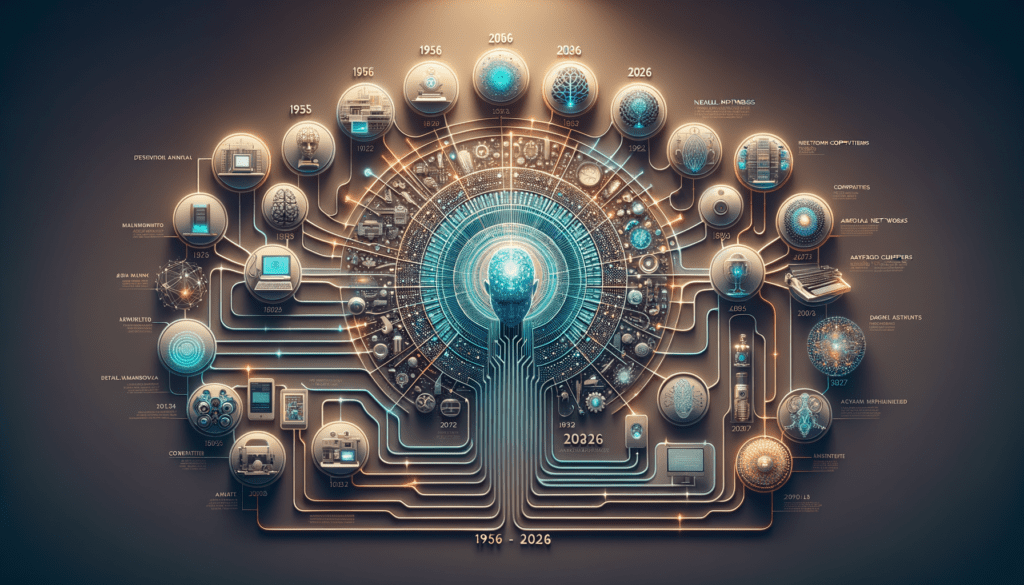
When was AI invented? AI was officially born in 1956, at the Dartmouth Conference in the United States. That is where the term artificial intelligence was first used.
The theoretical groundwork had been laid six years earlier, in 1950, in the work of Alan Turing. This article traces the history of AI, from the first ideas to today’s generative AI.
When did AI start? The first ideas
The story of when AI started begins with the idea that machines might be able to think. For centuries, philosophers and mathematicians had reflected on formal reasoning, logic and what intelligence actually is.
The practical step towards artificial intelligence only became possible with the rise of digital computers in the 1940s. Until then, AI existed only as a philosophical concept.
In 1950, the British mathematician Alan Turing published the paper “Computing Machinery and Intelligence“. In it, he asked the question that became the basis of the entire field: can machines think?
To make that question measurable, he introduced the Turing test. This is a method for deciding whether a machine shows intelligent behaviour that cannot be distinguished from human behaviour. His work laid the theoretical foundation on which the field is built, six years before AI was recognised as a discipline in its own right.
When was AI invented as a term?
The term AI was first used in 1956, at the Dartmouth Conference (officially the Dartmouth Summer Research Project on Artificial Intelligence) at Dartmouth College in the United States. The conference was organised by John McCarthy, Marvin Minsky, Nathaniel Rochester and Claude Shannon.
It was McCarthy who proposed calling the new field artificial intelligence. The conference itself produced no major scientific breakthroughs, but it mattered in a different way.
It established AI as a research field in its own right, with its own goals: getting machines to learn, reason and solve problems became the central ambitions. That is why 1956 counts as the official year AI was born as a discipline, even though its theoretical roots lay six years earlier with Turing.
What were the first AI programs?
The first AI programs appeared even before the Dartmouth Conference. In 1955, Allen Newell and Herbert Simon developed the Logic Theorist, a computer program that could prove mathematical theorems through symbolic manipulation without a pre-programmed solution method.
The Logic Theorist is regarded as the first real AI program in history. In the 1960s, it was followed by ELIZA, developed by Joseph Weizenbaum at MIT.
ELIZA simulated a conversation with a psychotherapist by rephrasing the user’s sentences as questions. It was the first chatbot in the history of AI, and it revealed something striking: people are quick to attribute human qualities to systems that only recognise simple patterns.
The first neural networks were also built in this period. In 1986, David Rumelhart, Geoffrey Hinton and Ronald Williams described the backpropagation algorithm, a method that allowed neural networks to learn more efficiently.
This algorithm would only show its full potential decades later, once computing power and data were finally available in sufficient quantities. The way modern AI systems work builds directly on these early neural networks.
What were the AI winters?
The AI winters were periods of stagnation that followed the optimistic early years. The first AI winter began in the 1970s.
Computers lacked the computing power and memory to deliver on the ambitious goals, and investors withdrew their funding when the promises were not kept.
In the 1980s, there was a temporary revival through expert systems, programs that captured the knowledge of human experts in rules and decision trees. MYCIN could diagnose bacterial infections, and XCON from Digital Equipment Corporation configured computer systems to order.
These systems worked well for specific, well-defined problems, but were brittle outside their own domain. A second AI winter followed at the end of the 1980s.
The limitations of expert systems became clear, investment dried up again and hundreds of AI companies went bankrupt. It took until the 1990s for the tide to turn.
How did the internet change the history of AI?
The internet changed the history of AI profoundly. The combination of vast amounts of available data, cheaper storage and faster processors gave machine learning the fuel it had always needed.
For the first time, training material was available on a large scale, and the computing power to process it grew exponentially. What had seemed a theoretical problem suddenly became solvable.
In 1997, IBM’s Deep Blue beat world chess champion Garry Kasparov. It was a milestone that drew attention worldwide and showed that computers could outperform humans at a specific, complex task.
In the years that followed, AI began to find its way into everyday applications. Search engines, spam filters and recommendation systems became the first AI applications that large numbers of people dealt with every day, often without realising it.
When did the deep learning revolution begin?
The deep learning revolution began in 2012. That year, AlexNet, a system developed by Alex Krizhevsky, Ilya Sutskever and Geoffrey Hinton, convincingly won an international image recognition competition.
AlexNet performed so much better than the competition that it caught the attention of the entire research field. From then on, deep learning (training deep neural networks on large datasets) became the dominant method in AI research.
In the years that followed, speech recognition improved greatly, translation systems became more accurate and available computing power kept growing. That combination made ever larger and more capable models possible.
The different types of AI that came out of this revolution together make up the range of AI tools professionals work with today.
When did generative AI emerge?
Generative AI emerged in the late 2010s, but broke through to a broad public with the launch of ChatGPT in November 2022. Before that, OpenAI had released GPT-3 in 2020, a language model that could generate text of a quality that had not been possible before.
ChatGPT made that technology accessible to everyone through a simple chat interface.
During the period when I used ChatGPT intensively for SEO work, I built several custom GPTs with it, including ones for keyword research and content briefs.
The rapid adoption was visible worldwide: within a few days of the release, large numbers of users had created an account. That speed accelerated investment and development at competitors such as Google, Anthropic and Meta.
The breakthrough of 2022 was closely linked to the decision by the makers of ChatGPT to open the chatbot to everyone for free during the research phase.
Would you like to learn to work with the language models that came out of this history? In LearnLLM’s ChatGPT Course, you build up a way of working step by step, using tasks from your own job.
Frequently asked questions about when AI was invented
In the story of how AI was invented, a few later milestones often get too little attention, even though they explain where today’s language models come from.
When was the transformer invented?
The transformer was introduced in June 2017 in the paper Attention Is All You Need by Ashish Vaswani and seven co-authors. The architecture relies entirely on an attention mechanism and drops the recurrent and convolutional networks that had been standard for language until then. In its technical report, OpenAI describes GPT-4 as a model based on the transformer.
Has an AI passed the Turing test?
Yes, according to a study by Cameron Jones and Benjamin Bergen from March 2025, a language model passed a standard three-party Turing test for the first time. Participants chatted for five minutes with a human and an AI system at the same time and had to choose which one was the human. GPT-4.5, instructed to adopt a human persona, was judged to be the human 73 per cent of the time, more often than the real participants. ELIZA scored 23 per cent in the same test.
Which Nobel Prize went to research that made modern AI possible?
The 2024 Nobel Prize in Physics, awarded to John Hopfield and Geoffrey Hinton, went to research that made modern AI possible. On 8 October 2024, the Royal Swedish Academy of Sciences honoured them for discoveries and inventions that enable machine learning with artificial neural networks. Hinton is the same researcher who co-authored the 1986 backpropagation paper and co-developed AlexNet in 2012.