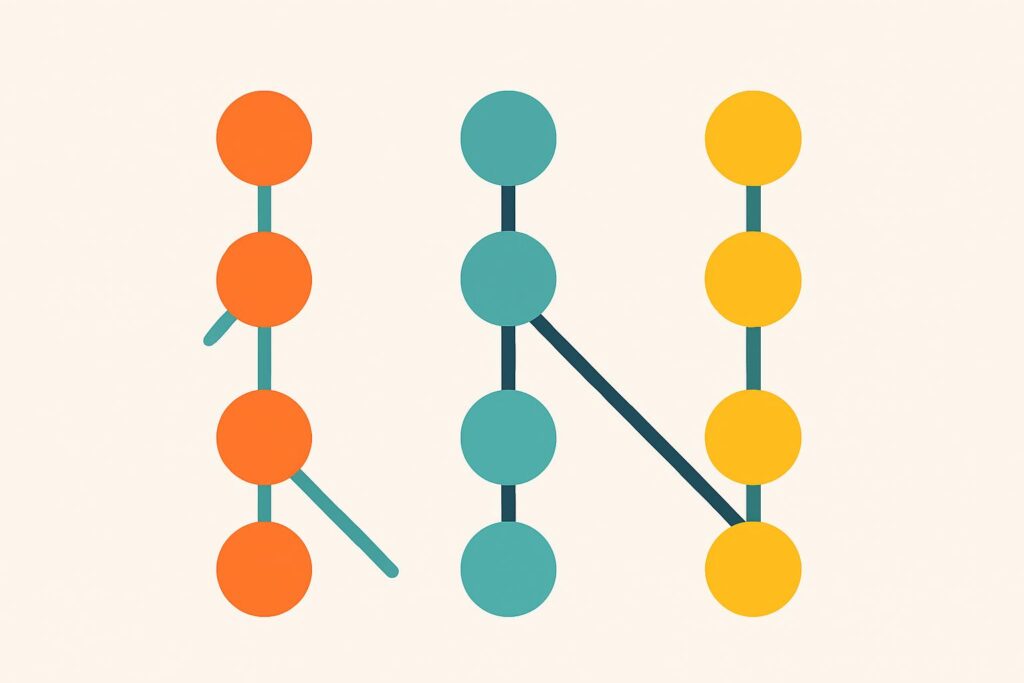
What is a neural network? A neural network is the computational structure behind most modern AI, including ChatGPT, Claude and speech recognition. Within artificial intelligence, neural networks are the building block that lets systems learn patterns from examples instead of following fixed rules.
A neural network consists of neurons arranged in layers, connected by weights that determine how much each signal counts. Input passes through the network layer by layer until an outcome appears at the end.
Learning happens during training: the network makes a prediction, measures the error and adjusts the weights using backpropagation. That cycle repeats until the predictions are good enough.
A neural network recognises patterns, but contains no knowledge or understanding. That very difference determines how you handle the output of AI tools at work.
What is a neural network?
A neural network is a computational model that learns to recognise patterns by processing many examples and uses those patterns to make predictions about new input. The full name is “artificial neural network”, because its structure is loosely inspired by nerve cells in the brain.
A spam filter that has learned from a large number of labelled emails and assesses new messages on that basis is a simple example. A large language model applies the same principle on a much larger scale.
What is a neural network made of?
A neural network consists of three parts: neurons, the weights between those neurons and the layers in which the neurons are arranged.
What does a neuron do in a neural network?
A neuron in a neural network is a small computing unit that receives numbers, applies a weight to each and adds them up, and passes the result on to the next layer. An activation function determines how strongly the neuron responds to the summed input.
Thanks to that activation function, a network can also learn relationships that are not directly proportional, such as the combination of words that together point to spam.
What are weights in a neural network?
Weights in a neural network are the numbers the network adjusts during training. A weight determines how much an incoming signal counts; the bias is a starting value for each neuron that shifts the threshold at which the neuron responds.
A large language model contains billions of these numbers. Together they make up everything the model has captured from its training.
What layers does a neural network have?
A neural network has three types of layer: the input layer receives the data, the hidden layers process that data and the output layer gives the outcome. In a spam filter, the input layer receives the words of an email and the output layer gives a single number: the probability that the message is spam.
A network with many hidden layers is called a deep network.
A network with many hidden layers is called a deep network, and that is where the term deep learning comes from.
How does a neural network process information?
A neural network processes information layer by layer, in one direction from input to output; this step is called the forward pass. Each neuron receives the signals from the previous layer, multiplies them by the weights, adds them up and passes the result on.
After the last layer there is an outcome, such as the probability that an email is spam or the most likely next word in a sentence. Nothing in the network changes during use: the weights are fixed after training, and new input only runs through the existing calculation steps.
How does a neural network learn?
A neural network learns by adjusting its weights step by step until its predictions deviate as little as possible from the correct answers. Three concepts describe that learning process: training, backpropagation and overfitting.
What happens when a neural network is trained?
When a neural network is trained, the model processes training data for which the correct answer is known, and compares each prediction with that answer. A loss function expresses the difference as a single number: the bigger that number, the further off the network was.
Training means repeatedly lowering that number over a very large number of rounds. Training stops when that number barely falls any further or when the score on test data gets worse.
What is backpropagation?
Backpropagation is the calculation method a neural network uses to determine how much each weight contributed to an error. The error is calculated back through the network from the output layer, layer by layer, and each weight moves a small step in the direction that reduces the error.
That direction is called the gradient. David Rumelhart, Geoffrey Hinton and Ronald Williams described the method in 1986 in Nature, and modern neural networks are still trained with it.
What is overfitting?
Overfitting means that a neural network memorises its training data instead of learning the underlying pattern. Such a network scores very well on examples it already knows and poorly on new cases.
Developers therefore check for it with test data: examples the network never processed during training.
Is a neural network like the human brain?
No, a neural network resembles the human brain only in its basic idea: many simple units passing signals through connections of varying strength. In the brain those connections are called synapses; in a neural network they are weights.
Research from 2009 counted an average of around 86 billion nerve cells in the brains of adult men. Those cells work chemically and electrically and adapt constantly. An artificial neuron is a calculation, not a nerve cell.
The comparison with the brain was a source of inspiration in the early days of the field; it is not a description of how an AI model works.
What types of neural network are there?
Four types of neural network are the most common in practice, each built for a different type of data:
- Feedforward networks: the simplest form, in which signals run in one direction from input to output, for example for a risk score.
- Convolutional networks: specialised in images, because they analyse small parts of an image separately, for example when reading scans.
- Recurrent networks: built for sequences such as speech and time series, because they carry information from the previous step to the next.
- Transformers: built for language, and described by Ashish Vaswani and colleagues in 2017 in the paper “Attention Is All You Need”.
A transformer weighs all the words in a text against each other at the same time, instead of one by one. Almost every large language model, also known as an LLM, runs on this architecture; the T in GPT, the model behind ChatGPT, stands for transformer.
What can’t a neural network do?
A neural network contains no knowledge and no understanding, only numbers that capture patterns from the training data. That is why a language model can give an answer that sounds like a fact when it is only the most likely continuation.
The network is also a black box: the billions of weights don’t show why it arrived at an answer. For anyone who uses AI output in advice, a deed or a set of annual accounts, the network is therefore never the source.
The source is the case file, the law or the figures you check yourself.
What is the difference between a neural network and deep learning?
A neural network is the building block; deep learning is the approach in which you train such networks with many layers on large amounts of data. A network with one or two hidden layers is a neural network, but not yet deep learning.
You only speak of deep learning when there are many successive layers, in which each layer recognises a more abstract pattern than the one before.
Is a neural network the same as AI?
No, a neural network is not the same as AI, because AI is the whole field and a neural network is one technique within it. Neural networks fall under machine learning, the branch of AI in which systems learn from data.
There are also AI systems without a neural network, such as rule-based systems that follow fixed if-then rules.
Is ChatGPT a neural network?
Yes, ChatGPT runs on a neural network, because OpenAI’s GPT models are large transformer networks with billions of weights. ChatGPT itself is the service around them, with the chat interface, the memory feature and the connections to search and files.
Within that service, the language model (a neural network) predicts the text of each answer.
Does a neural network store your data?
No, a neural network doesn’t store your data during use, because the weights are fixed after training and your input only passes through them. What happens to your input is determined by the provider of the service.
The terms and settings of that service determine whether conversations are kept and used to train future models. For confidential client data, that policy is what matters, not how the network works.
How long have neural networks existed?
Neural networks date back to 1943, when Warren McCulloch and Walter Pitts published a mathematical model of a nerve cell. In 1958, Frank Rosenblatt described the perceptron, a network that adjusted its own weights based on examples.
In 1986, backpropagation made it practical to train networks with several layers. In 2024, John Hopfield and Geoffrey Hinton received the Nobel Prize in Physics for discoveries that enable machine learning with artificial neural networks.
Frequently asked questions about neural networks
People also ask about the word itself and about how to experiment with neural networks without programming.
What does neural mean?
“Neural” means relating to nerves or the nervous system, and the word goes back to the Greek “neuron”, meaning “nerve”. In a neural network it refers to the loose inspiration from nerve cells in the brain, not to biological tissue. According to the Online Etymology Dictionary, the word “neural” has been in use in English since 1830.
What are parameters in a neural network?
Parameters in a neural network are the weights and biases the model learns during training. The number in a model name, such as the 31B in Gemma 4 31B, stands for the number of parameters, in this case 31 billion. Hyperparameters are something else: they are settings a developer chooses for the training, such as the learning rate.
Can you experiment with a neural network yourself?
Yes, you can experiment with a neural network without installing anything in the TensorFlow Playground, an open-source visualisation that runs in your browser. There you can set the activation function and the learning rate, among other things, and see how a small network learns a pattern in sample data. For office work with AI tools, an experiment like this isn’t required, but it shows what training means in practice.
How do you learn to work responsibly with AI tools that run on neural networks?
You learn to work responsibly with AI tools that run on neural networks by linking how they work to how you check their output. Neurons and weights capture patterns, not facts, so you test every outcome. You don’t need to calculate backpropagation or train a network yourself to do that.
LearnLLM provides that foundation in its AI Literacy Course with practical assignments on your own work, finishing with a certificate of completion.