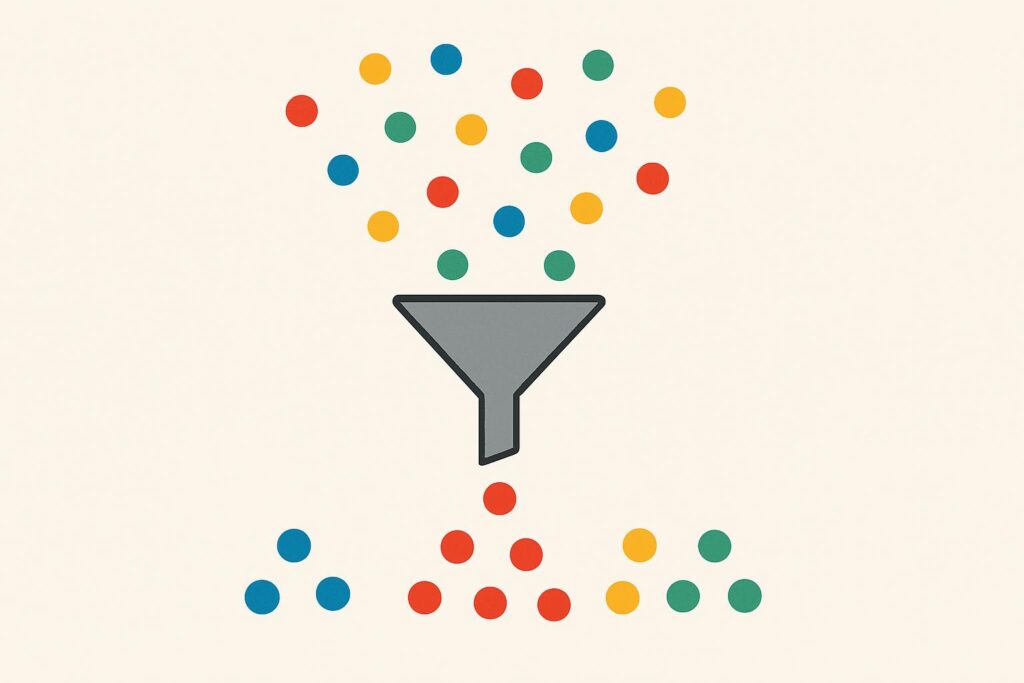
What is machine learning? Machine learning is a way of getting computers to perform tasks by learning patterns from examples rather than from rules written in advance.
A machine learning model first trains on data; you then test it on new examples and put it to work making predictions.
Examples are everywhere: in the spam filter in your inbox, in fraud detection for payments and in the recommendations of an online shop.
Machine learning is a subfield of artificial intelligence: every application of machine learning falls under AI, but not all AI learns from data. ChatGPT, Claude and Gemini were built with machine learning, and the same technique explains their limitations.
What does machine learning mean?
Machine learning means that a computer program gets better at a task the more examples it processes, without anyone prescribing every rule.
In his 1997 book, Tom Mitchell of Carnegie Mellon University described machine learning as the study of algorithms that improve automatically through experience. The term itself is older. Arthur Samuel used it in 1959 in the title of a paper in the IBM Journal of Research and Development, about a program that learned to play draughts (checkers).
How does machine learning work?
Machine learning works in five steps. A spam filter illustrates them well.
The first step is collecting data: thousands of emails. In the second step, each email gets a label, spam or not spam. Then, in step three, an algorithm trains on that labelled data and looks for features that set spam apart, such as certain words, senders or links.
That training produces a model: a set of calculation rules that works out the probability that a new email is spam. In step four you test the model on emails it has not seen before, because a model that only knows its training data well disappoints in practice.
In step five the model goes into use and predicts for every incoming email whether it belongs in the spam folder. When it comes to how AI works, steps one to four form the learning phase; step five applies the trained model.
- Collect dataGather thousands of emails.
- LabelMark each email as spam or not spam.
- TrainAn algorithm finds features that set spam apart, such as words, senders or links.
- TestCheck the model on emails it has not seen before.
- Put into useThe model predicts for each incoming email whether it is spam.
Steps 1 to 4 are the learning phase; step 5 applies the trained model.
What are the types of machine learning?
There are three main types of machine learning: supervised learning, unsupervised learning and reinforcement learning. A fourth variant is semi-supervised learning, a hybrid that works with a small amount of labelled data and a lot of unlabelled data.
The table summarises, for each type, which data it uses, what it learns and an example.
| Type | Data | What it learns | Example |
|---|---|---|---|
| Supervised learning | Examples with the correct answer included | Predicting a category or number | Assigning invoices to general ledger accounts |
| Unsupervised learning | Examples without an answer | Finding groups and patterns | Segmenting customers by behaviour |
| Reinforcement learning | Reward or penalty after an action | Choosing the best sequence of actions | A program that learns to play a game |
What is supervised learning?
Supervised learning is learning from examples where the correct answer is already known. For instance, a model studies thousands of posted invoices to learn which general ledger account a new invoice belongs to.
Those pre-labelled examples make supervised learning suitable for classification (choosing between categories) and for predicting numbers.
What is unsupervised learning?
Unsupervised learning looks for patterns in unlabelled data, where there is no known answer in advance. A well-known application is clustering: grouping customers by behaviour, where the model itself determines which groups exist.
A person then judges whether those groups mean anything. The model does not provide names or explanations.
What is reinforcement learning?
Reinforcement learning is learning by acting and receiving a reward or penalty for it. A program tries out actions, gets a score for each one and adjusts its behaviour to increase the total reward.
Games are a well-known application. A variant that uses human ratings plays a role in language models, as the section on ChatGPT below shows.
Which machine learning models are there?
There are four widely used types of machine learning model, each suited to a different type of question:
- Regression: predicts a number, such as the expected processing time of a case file based on earlier files with similar characteristics.
- Decision tree: makes a choice through a series of yes-or-no questions, which makes the outcome easy to trace for whoever checks it.
- Clustering: divides data into groups that resemble each other, without categories known in advance, such as customer segments or types of question.
- Neural network: calculates through layers of connected computing units and forms the basis of deep learning, image recognition and language models.
What are examples of machine learning?
You come across examples of machine learning every day, including in office software:
- Spam filter: classifies incoming email as normal or unwanted based on messages assessed earlier.
- Fraud detection: spots payments that deviate from an account holder’s normal pattern and holds them for review.
- Recommendations: suggests products, articles or videos based on what similar users viewed or bought before.
- Document classification: automatically sorts incoming post, invoices or documents by type, client or case file.
- Speech recognition: converts a recorded conversation or dictation into text, the basis of automatic minutes.
What is the difference between AI and machine learning?
AI and machine learning differ in scope. AI is the broad field of systems that perform tasks that seem to require human intelligence; machine learning is one way of building such systems.
So is machine learning AI? Yes, machine learning falls under AI, but not all AI is machine learning.
A rule-based system, such as a program that follows fixed if-then rules, also falls under AI but does not learn from data. Machine learning, by contrast, derives those rules itself from examples.
Is ChatGPT machine learning?
Yes, ChatGPT was built with machine learning: the underlying language model learned its abilities from data. ChatGPT runs on an LLM, a large language model trained with deep learning.
Such a model first learns by processing enormous amounts of text and repeatedly predicting the next word. OpenAI described that pre-training in 2020 in a paper on an earlier generation of its GPT models.
A second learning phase followed. At the launch in November 2022, OpenAI wrote that ChatGPT was first trained with supervised fine-tuning and then with reinforcement learning from human feedback, in which people ranked answers.
Anthropic’s Claude and Google’s Gemini are also large language models trained with machine learning. Text, images or code that such models produce fall under generative AI, the branch of AI that produces new content.
What are the limitations of machine learning?
Machine learning has four limitations that determine how far you can trust an outcome. The first is bias: a model takes on the skew in its training data. If certain groups are under-represented, the model assesses those groups less accurately.
The second is data quality. Errors, gaps and outdated records in the training set come back in every prediction.
The third is explainability. With complex models such as neural networks, it is hard to trace how the model reached a particular outcome, which is a problem when you have to justify a decision.
The fourth is overfitting: a model that knows its training data almost by heart but performs poorly on new cases. Together, these limitations make human review of the outcome necessary, especially for decisions about people.
What is the difference between machine learning and deep learning?
Deep learning is a form of machine learning that works with neural networks of many layers. That depth makes deep learning suitable for text, images and speech, but it needs far more data and computing power than classic models such as a decision tree.
Does machine learning fall under the AI Act?
Yes, machine learning falls under the EU AI Act when it is part of an AI system as the regulation defines it. Recital 12 of Regulation (EU) 2024/1689 explicitly names machine learning approaches, which learn from data, as a technique behind an AI system.
Which obligations apply depends on the risk level of the application and on your role, not on the technique. From 2 February 2025, Article 4 required AI literacy from those who provide or use AI systems. Since 27 July 2026, it has covered measures that support the development of AI literacy, without a particular level having to be guaranteed.
Frequently asked questions about machine learning
If you want to get started with machine learning yourself, questions soon come up about programming and about whether models keep learning.
Which programming language do you use for machine learning?
For machine learning you will often use Python, the language behind many well-known libraries, such as scikit-learn, which describes itself as machine learning in Python. Scikit-learn is open source under a BSD licence, can also be used commercially and builds on NumPy and SciPy. For deep learning with neural networks, PyTorch and TensorFlow are widely used libraries with a Python interface.
Can you use machine learning without programming?
Yes, you can use machine learning without programming through AutoML, software that largely automates building a model. In Azure Machine Learning studio, Microsoft offers a web interface where you can have a model trained and tuned towards a target metric you choose, with little or no code. You still have to supply good data and judge for yourself whether the outcome is usable.
Does a machine learning model keep learning once it is in use?
A machine learning model only keeps learning after deployment if it is retrained. Google calls a model that is retrained regularly or even continuously a dynamic model; a model that is not retrained works with what it learned during training. With ChatGPT, OpenAI uses conversations on personal accounts (Free, Go, Plus and Pro) for further training of its models, unless you switch that off in the settings. On Business, Enterprise and Edu, OpenAI does not train on workspace data.
How do you learn to work responsibly with AI systems?
You learn to work responsibly with AI systems by understanding how a model built with machine learning arrives at an outcome and where it goes wrong. In the AI Literacy Course, you learn how a language model arrives at an answer, where bias and hallucinations come from and what the GDPR and the AI Act require.
You finish with an internal AI policy for your organisation.