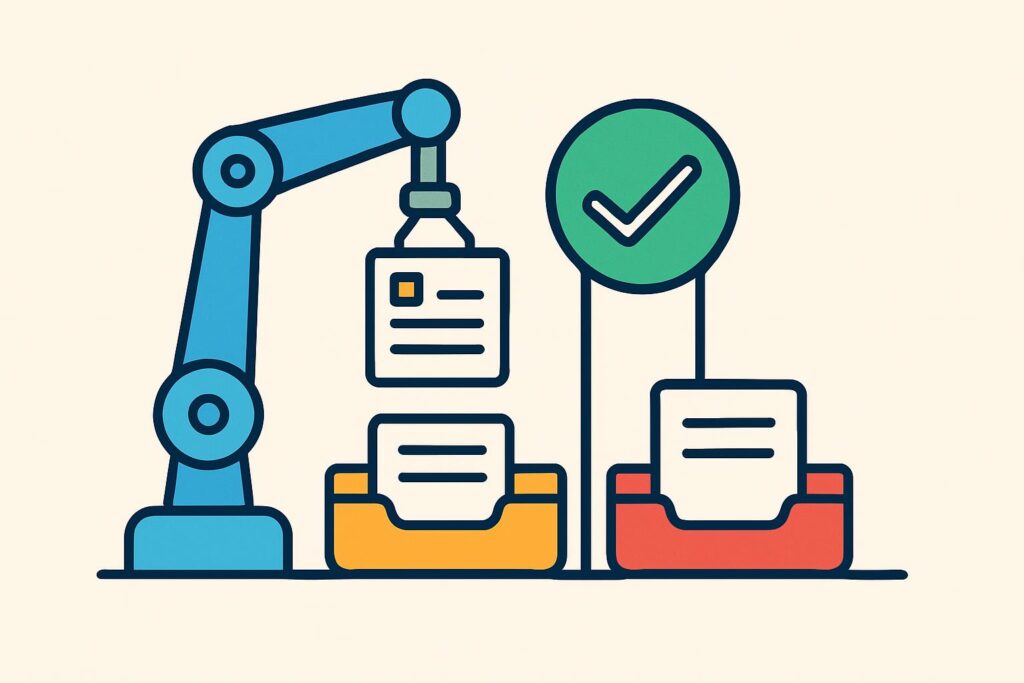
AI agents for business take over clearly defined tasks in customer service, sales, marketing, finance and HR, and in sectors such as accountancy, notarial practice and marketing agencies. Within AI agents and automation, agents are the form that takes steps in your systems on its own, and therefore the form that needs the most control.
What an agent does differs from department to department: answering questions, qualifying leads, matching invoices or scheduling appointments. Between sectors, it is mainly the professional rules governing the outcome that differ.
A process is suitable for an AI agent when it is repeatable, comes from digital sources and has a verifiable outcome. Errors arise from overly broad permissions, wrong actions and instructions hidden in documents.
The checking step determines whether an agent is usable in a business. A person approves what the agent sends out, and the agent only gets the permissions the task requires.
What does an AI agent do in a business?
An AI agent in a business carries out a task in several steps, with access to systems such as email, a CRM or accounting software. What sets AI agents apart from a chatbot is that they carry out actions themselves instead of only returning text.
In a business, that means the agent reads an incoming message, looks up data, drafts a reply or a booking and either queues it up or sends it. Every step in which the agent changes or sends something is a step in which an error can go out of the door.
Which departments can use AI agents?
AI agents are useful for five departments with a lot of repeatable work: customer service, sales, marketing, finance and HR. Below, you will find for each department what the agent does and where the check sits.
Customer service
In customer service, an AI agent answers frequently asked questions, routes tickets to the right employee and drafts replies. Brynjolfsson, Li and Raymond (QJE, 2025) followed 5,172 customer service agents at one company using an AI assistant that suggested replies. Those agents resolved 15 percent more issues per hour; that figure is about throughput, not time saved.
Sales
In sales, an AI agent qualifies incoming leads, updates the CRM after a conversation and drafts follow-up emails. The check sits with the email: an agent that sends on its own makes commitments on behalf of the company.
Marketing
In marketing, an AI agent creates content variants for each audience, collects results from advertising platforms and prepares reports. Publishing remains a human step, because an error is immediately visible to customers.
Finance
In finance, an AI agent reads invoices, matches them with orders and flags anomalies such as duplicate invoices. The agent proposes the booking; an employee approves payments.
HR
In HR, an AI agent schedules meetings, answers questions about internal policies and prepares onboarding. Recruitment calls for extra caution: AI systems for recruitment fall under Annex III of the EU AI Act, with obligations for high-risk systems from 2 December 2027.
How are AI agents for business used in each sector?
In each sector, the uses of AI agents follow the work that recurs most often there, within the professional rules that apply. That looks different for accountancy, notarial practice and marketing agencies.
Accountancy
In accountancy, an AI agent requests missing documents from clients, prepares files for the annual accounts and flags anomalies in bookings. In the Netherlands, other firms with assurance or compilation engagements fall under the NVKM quality management standard from 1 January 2027; agreements on AI use belong in the quality system there as a control measure. If you use AI for accountants, you remain responsible as an accountant for every outcome an agent delivers.
Notarial practice
In notarial practice, an AI agent organises intake data, prepares file overviews and checks whether all documents are in before a deed is drawn up. In the Netherlands, the AI weighing scale published by the Royal Dutch Association of Civil-law Notaries (KNB) in November 2025 is the assessment framework, and because of the duty of confidentiality in Article 22 of the Dutch Notaries Act (Wna), the choice of tool and storage location carries a lot of weight.
Marketing agencies
In marketing agencies, an AI agent compiles client reports, processes data from Search Console and advertising platforms and prepares content briefings. Since the December 2025 core update, I have seen in Search Console for client sites that AI content without human input has lost traffic, so final editing of client content remains human work.
Which processes are suitable for an AI agent?
A process is suitable for an AI agent when it meets four conditions: repeatable work, a source with an API or export, a verifiable outcome and no professional judgement. Processing, standardising and summarising documents meets them; a legal review does not.
Start with one process rather than a company-wide strategy. A process without an API or export is ruled out, because the agent then works through workarounds that break when a system changes.
Where do AI agents go wrong in a business?
AI agents in a business go wrong in three places: wrong actions, overly broad permissions and hidden instructions in documents. All three are more serious because an agent acts on its own instead of only delivering text.
OWASP puts prompt injection first (LLM01) on its 2025 list of risks for language model applications. In indirect prompt injection, instructions sit in a website or file the agent reads, so the agent does something other than intended.
Wrong actions arise partly from tasks outside what AI does well. Dell’Acqua et al. (Organization Science, 2026) ran an experiment with 758 BCG consultants. On one task deliberately chosen to lie outside the AI frontier, participants with AI support gave a correct answer 19 percentage points less often.
How do you set up the checking step for an AI agent?
You set up the checking step for an AI agent with four measures: human approval before every external action, minimal permissions, a log of every step and a spot check afterwards. An agent that only prepares drafts carries less risk than an agent that sends on its own.
From banking practice, I translate the four-eyes principle into AI checkpoints at SME scale: not a full compliance department, but a designated person who approves and a documented way of working. For the automations I build with AI as a building partner, I start with the question of what data goes in, where it ends up and who has access to it.
Can small businesses use AI agents?
Yes, small businesses use AI agents for clearly defined processes such as intake, reporting or processing invoices. Without an IT department, the limit lies in maintenance: choose a process you can oversee yourself, and one where the work carries on if you shut the agent down.
What is the difference between an AI agent and ordinary automation?
Ordinary automation follows fixed rules; an AI agent decides for itself which step comes next within a task. The need for control follows from the difference between AI and automation: a fixed rule does the same thing every time, an agent does not.
Frequently asked questions about AI agents for business
If you use AI agents for business in contact with customers, you will face rules that go beyond the technology.
Do you have to tell customers they are talking to an AI agent?
Yes, under Article 50(1) of the AI Act, an AI agent that communicates directly with customers must be designed so that people know they are dealing with AI. The obligation only lapses if this is already obvious from the context to a reasonably well-informed person. The rule has applied since 2 August 2026 and rests with the provider of the system, including when your company builds the agent itself and uses it under its own name.
Can an AI agent process customers’ personal data?
An AI agent may process customers’ personal data if you have a legal basis for it under the GDPR and make agreements with the supplier that processes the data for you. According to the Dutch Data Protection Authority (Autoriteit Persoonsgegevens, AP), the GDPR then requires a data processing agreement, and as the controller you always remain responsible. In your privacy statement, you list the recipients of the data and whether you use automated decision-making. If the agent itself takes decisions with legal effects, Article 22 of the GDPR applies.
How does a firm start with its first AI agent?
As a firm, you start with your first AI agent by choosing one work process and defining the source and the checking step. Then you have the automation for that one process built. In the AI Automation Course, you build such a clearly defined automation yourself, for one work process from your own practice and with a checking step.