Zero-shot prompting means giving an AI model a task without any examples of the desired outcome: just an instruction and, optionally, some context. Within prompting, every question you ask ChatGPT without an example counts as a zero-shot prompt.
Zero-shot works well for tasks whose form a language model has seen many times in its training, such as summarising, rewriting and translating. For your own house style or a fixed format, an instruction without an example often falls short.
A zero-shot prompt gets better when you add the goal, reader, context, format and limits. If a better instruction no longer produces a better outcome, few-shot prompting with a few examples is the next step.
What does zero-shot prompting mean?
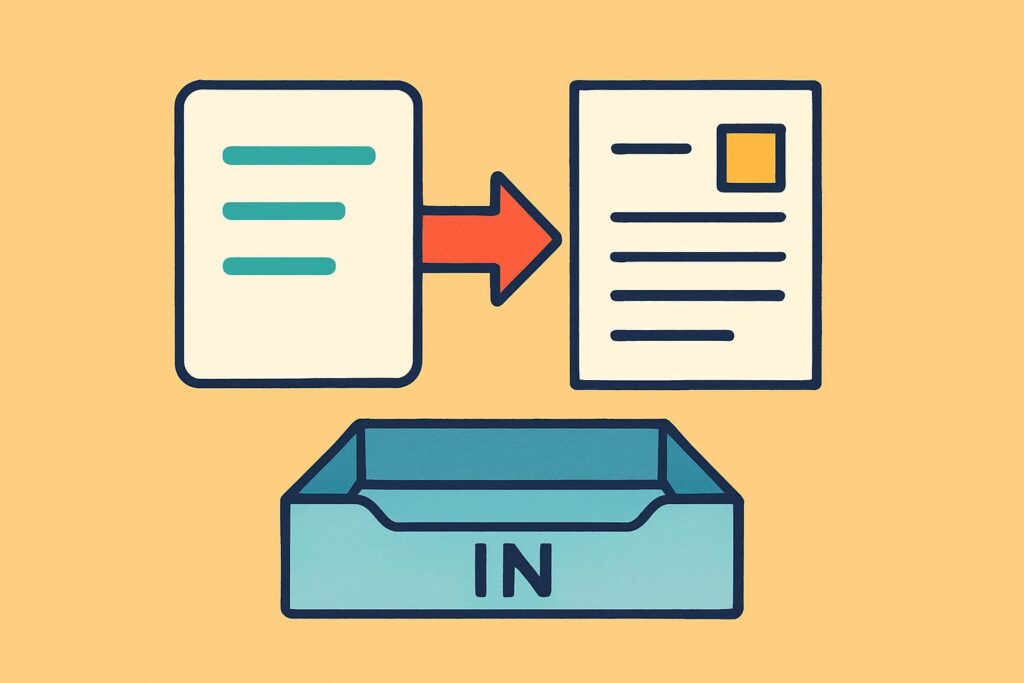
Zero-shot prompting means giving an AI model a task without examples of the desired outcome, only an instruction. The “zero” refers to the number of examples.
For language models, the term became widely known through the 2020 paper “Language Models are Few-Shot Learners” by Tom Brown and colleagues at OpenAI. In it, zero-shot is the situation in which the model only receives a plain-language description of the task, without demonstrations.
How does zero-shot prompting work?
Zero-shot prompting works because a language model has already processed a huge number of tasks in text form during training, such as summaries, translations and classifications. A language model therefore recognises your instruction as a familiar kind of task and carries it out without you having to demonstrate the form.
Instruction tuning strengthens that effect. In this extra training step, a model learns to respond to instructions, and in 2021 Jason Wei and colleagues showed that instruction tuning greatly improves zero-shot performance on unseen tasks.
What does a zero-shot prompt look like in your work?
A zero-shot prompt in your work is an instruction in ChatGPT with a clear task, context and desired format, but without an example. Two versions of the same instruction show the difference:
Weak: Summarise this email.

Strong: Summarise the email below from a client in three sentences for a colleague who is taking over the file. Mention the client's question, the deadline they gave and what the client still expects from our office.
Both prompts are zero-shot. The second prompt names the reader, the length and the three points that need to be included, so ChatGPT has less to fill in itself.
Which tasks does zero-shot prompting work well for?
Zero-shot prompting works well for tasks whose form the model has seen often in its training and whose outcome you can describe in words. Five office tasks are well suited to it:
- Summarising: cutting an email, minutes or a report down to the key points for a specific reader.
- Rewriting: making a text simpler, more formal or shorter without changing the content.
- Classifying: sorting emails, complaints or invoices into categories you name yourself in the prompt.
- Translating: converting a text into another language, with an instruction on tone and form of address.
- Drafting: writing a first version of an email, agenda or checklist as a starting point for your own editing.
For all these tasks, the desired outcome can be described in words. An example adds little.
When does zero-shot prompting not work?
Zero-shot prompting does not work well when the desired outcome is hard to capture in words. House style is the clearest example: the instruction “write in our tone” gives a model nothing to go on without a sample text.
The same applies to a fixed format of your own, such as the structure of an advisory report, and to your own categories that differ from common classifications. Zero-shot prompts are also sensitive to wording: a small change in the instruction sometimes gives a noticeably different outcome.
During the period when I used ChatGPT intensively, I consistently found that with more complex prompts containing several conditions, it ignored part of the instructions. That experience forced me to split large prompts into smaller steps.
How do you improve a zero-shot prompt without examples?
To improve a zero-shot prompt without examples, add five elements to the instruction:
- Goal: what the output is for, such as a management decision or a reply to a client.
- Reader: who will read the text and what that reader already knows.
- Context: the background to the task, such as the file or the agreement that came before it.
- Format: the length, structure and layout of the answer.
- Limit: what the model should not do, such as filling in amounts or drawing conclusions.
Anthropic suggests a simple test: show your prompt to a colleague who knows little about the task. If the instruction is unclear to that colleague, Anthropic says it is unclear to Claude as well.
Context in particular determines quality, and giving context to an LLM works best when you include only the material that matters for that one task.
What is zero-shot chain-of-thought prompting?
Zero-shot chain-of-thought prompting is a zero-shot prompt in which you ask the model to reason step by step before answering. In 2022, Takeshi Kojima and colleagues showed that adding “Let’s think step by step” sharply raised the score on maths problems. On MultiArith, a test of arithmetic word problems, the score rose from 17.7 to 78.7 percent.
The technique helps with questions involving several calculation or reasoning steps, such as calculating a deadline or comparing two quotes. If you also give the model a worked example of the reasoning, you are using the broader technique of chain of thought prompting.
When do you switch from zero-shot to few-shot prompting?
You switch from zero-shot to few-shot prompting as soon as a better instruction no longer improves the format or tone of the output. With few-shot prompting, you give the model a few examples of the desired outcome, and the output then follows the format, tone and structure of those examples.
What is the difference between zero-shot and one-shot prompting?
With zero-shot prompting you give no example; with one-shot prompting you give exactly one. In the paper by Brown and colleagues, one-shot is the situation with one demonstration alongside the task description.
One example is enough to show a fixed layout, such as the structure of a standard email to clients.
Do OpenAI and Anthropic recommend zero-shot or examples?
OpenAI and Anthropic each recommend a different starting point. Anthropic calls examples one of the most reliable ways to steer Claude’s format, tone and structure, and recommends three to five examples.
For reasoning models, OpenAI instead advises trying zero-shot first and only adding examples when needed. The two recommendations fit together: start without examples and add them as soon as the format or tone is off.
Do reasoning models need examples?
No, reasoning models usually do not need examples, because these models first build up a line of reasoning internally before answering. OpenAI writes that reasoning models often do not need few-shot examples to produce good results.
For a fixed house style or a format of your own, an example remains useful with these models too.
Which task is best suited to zero-shot prompting at work?
The task best suited to zero-shot prompting at work is summarising: the form is universal and the quality is quick to check against the original. The best zero-shot task differs slightly by type of office.
Which task suits zero-shot prompting in an accountancy firm?
In an accountancy firm, zero-shot prompting works well for summarising long email exchanges with a client before a file is handed over. Checking is easy, because every amount and date mentioned can be traced back to the original emails.
Which task suits zero-shot prompting in a notary’s office?
In a notary’s office, zero-shot prompting works well for rewriting an explanation to a client in plain language. The legal content comes from the deed: the model only adjusts the wording, and the notary checks that the meaning stays the same.
Which task suits zero-shot prompting in a marketing agency?
In a marketing agency, zero-shot prompting works well for sorting keywords or customer responses into categories you list yourself in the prompt. A fixed house style for client copy, on the other hand, calls for few-shot prompting, with sample texts from the client.
Frequently asked questions about zero-shot prompting
Zero-shot prompting also raises questions about related terms and about the language you write the instruction in.
What is the difference between zero-shot prompting and zero-shot classification?
Zero-shot prompting is a way of giving instructions to a language model, while zero-shot classification is a machine learning task in which a model sorts items into categories it did not see during training. Hugging Face describes zero-shot classification as predicting a class the model did not encounter during training. A zero-shot prompt that sorts emails into your own categories applies the first concept to a task of the second.
Do you have to write a zero-shot prompt in English?
No, you do not have to write a zero-shot prompt in English, because models such as Claude handle most languages written in standard Unicode characters. Anthropic does advise stating explicitly which language the input is in and which language you want the answer in, because that improves reliability. If you want fluent text in a language other than English, ask for idiomatic language as a native speaker would write it.
Is a prompt with a role or system instruction still zero-shot?
Yes, a prompt with a role or system instruction stays zero-shot as long as it contains no example of the desired outcome. In the paper by Brown and colleagues, the distinction is only about demonstrations: with zero-shot, the model gets no example at all. A role or a formatting rule is an instruction, not a demonstration. If you put one worked example in the system instruction, the prompt becomes one-shot.
How do you learn to apply zero-shot prompting in ChatGPT?
You learn to apply zero-shot prompting in ChatGPT by practising task by task with a clear instruction and no examples, and only adding examples when the outcome is off. That way you learn to choose between zero-shot and few-shot prompting for each task.
In the ChatGPT Course, an e-learning from LearnLLM, you learn to work with ChatGPT on your own tasks, with practical assignments and a certificate of completion.