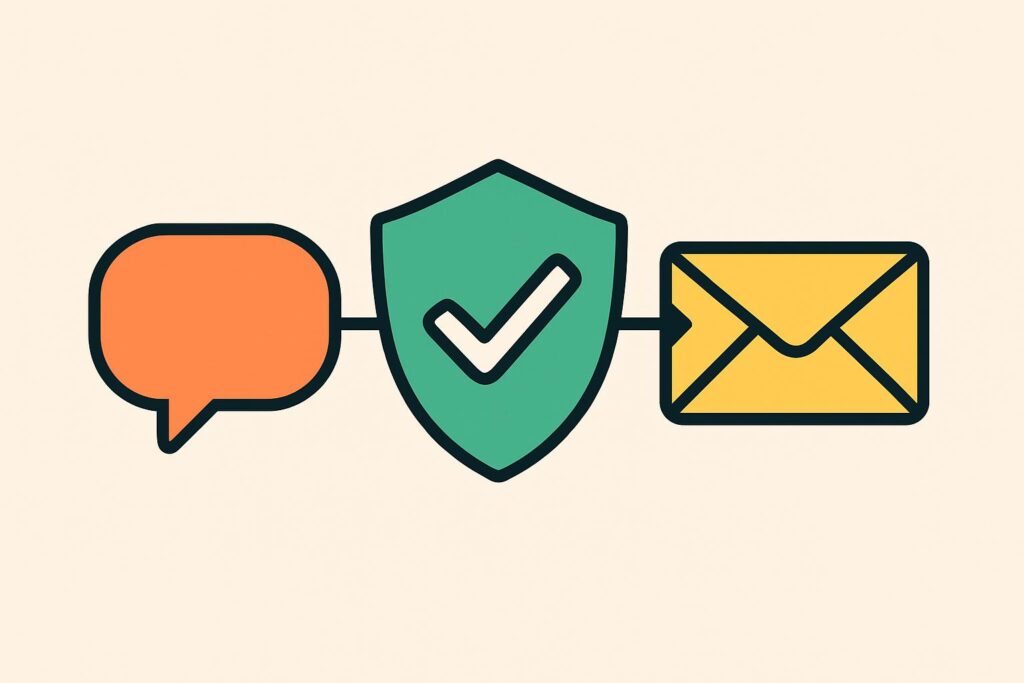
AI for customer service answers customer questions, sorts incoming messages and drafts replies. For an office of ten to fifty people, the most important choice is whether the AI answers on its own, through a chatbot, or helps an employee with a draft that the employee sends.
Which route fits depends on the question. AI can handle a question with a fixed answer on its own. A question where the answer is advice or a commitment belongs with an employee.
Where AI answers on its own, things go wrong at predictable points. The organisation remains responsible for what the chatbot says, and since 2 August 2026 customers must know that they are talking to AI.
A safe set-up therefore starts small: a defined set of questions, one managed source and always a route to a person.
How is AI used in customer service?
AI in customer service does four things: it answers customer questions, sorts and forwards messages, summarises earlier correspondence and drafts replies. Only in the first case does the AI talk to the customer directly.
- Answering: an AI chatbot on the website or in WhatsApp answers a question itself.
- Sorting: incoming emails get a subject and an urgency level and go to the right employee. With a few worked examples in the prompt, known as few-shot prompting, a model sorts more consistently.
- Summarising: a long email thread or case file is boiled down to the key points before someone responds.
- Draft reply: the employee gets a suggested answer, adjusts it and sends it themselves.
When do you choose a chatbot and when an AI assistant?
You choose a chatbot for customer questions with a fixed answer that need no human judgement. You choose an AI assistant when an employee must be able to stand behind the answer. The difference lies in who has the final say before the customer reads the reply.
Older chatbots work with a fixed decision tree and only give preprogrammed answers. Chatbots based on a language model generate their own wording, which reads more smoothly but also leaves room for made-up answers.
For an office where clients ask questions by email and phone, the assistant is usually the safer first step. The employee is still the one who answers, and the time saved comes from the drafting, not from skipping the check.
Which customer questions can AI handle on its own?
AI can handle customer questions on its own when the answer is fixed in a source you manage yourself and a mistake costs little. Examples are opening hours, which documents a client needs to provide, the status of an application and who someone should contact.
The condition is that the chatbot answers only from that source. A chatbot that makes up its own wording when an answer is missing turns a fixed question back into a risk.
Which customer questions belong with an employee?
Customer questions belong with an employee if the answer is advice, a commitment or an exception. Examples are a tax question at an accountancy firm, a question about a deadline at a notary’s office or a complaint about a completed assignment.
On top of that, a customer must always be able to reach a person. In an article about AI customer service, the Dutch consumer programme Radar describes one common complaint: the chatbot stuck in a loop, with no route to an employee.
Where does AI in customer service go wrong?
AI in customer service goes wrong at five predictable points:
- Made-up policy: the chatbot mentions a discount, deadline or exception that does not exist, because it sounds plausible.
- Outdated source: rates or terms have changed, but the source the chatbot answers from has not.
- Endless loop: the chatbot repeats the question, fails to recognise what the customer is asking and offers no route to an employee.
- Client data in the tool: employees paste case details into an AI tool for which there are no agreements on data processing.
- Wrong tone: a standard reply to a sensitive question, such as a bereavement or a payment problem, damages the relationship.
The made-up policy is a form of AI hallucination: a language model generates the most probable answer, not the correct one. A customer cannot see the difference.
Who is liable for a wrong answer from a chatbot?
The organisation that uses the chatbot is liable for what the chatbot says. The case of Moffatt v. Air Canada, decided by the Civil Resolution Tribunal of British Columbia on 14 February 2024, shows this.
Air Canada’s chatbot told a customer that he could apply for a bereavement fare retrospectively, although the policy did not allow it. Air Canada argued that the chatbot was a separate entity responsible for its own answers. The tribunal rejected that argument and ordered the airline to pay about 650 Canadian dollars in compensation, plus interest and costs.
The case is a Canadian ruling, not a rule of Dutch or EU law, but the reasoning applies generally: to the customer, an answer from the chatbot is an answer from the company.
What rules apply to AI in customer service?
Three sets of rules apply to AI in customer service: the transparency obligation in the AI Act, the GDPR and the ban on emotion recognition in the workplace.
Article 50 of the EU AI Act requires that customers know they are talking to an AI system. That obligation has applied since 2 August 2026 and was not postponed by the Digital Omnibus, which did move the rules for high-risk systems to 2 December 2027.
The GDPR requires a legal basis for processing customer data and a data processing agreement with the tool’s supplier. If a system takes a decision on its own that has legal effects, such as rejecting an application, the customer has a right to human intervention under Article 22.
The ban on emotion recognition in the workplace has applied since 2 February 2025 and affects customer service through the employees: software that measures stress or irritation in an employee’s voice is not allowed. The same limit applies to mood scores in meeting tools when you use an AI note taker.
How do you set up AI in customer service safely?
You set up AI in customer service safely by giving the AI a limited task, one managed source and a fixed check:
- Decide which customer questions the AI may answer on its own and which always go to an employee.
- Connect the AI to one source that you keep up to date yourself, and do not let it answer outside that source.
- Tell customers at the start of the conversation that they are talking to an AI system.
- Build a visible route to an employee into every conversation.
- Check a sample of conversations every month and update the source where answers went wrong.
From my years at major banks, I bring the four-eyes principle to AI work: nothing goes out the door without a second check. With a chatbot, that second check comes afterwards, through the sample. With an AI assistant, it comes beforehand, because the employee reads the draft.
How to start using AI in customer service
Using AI in customer service starts with a list of the ten questions clients ask most often, with a judgement for each one on how bad a wrong answer would be. The questions with a fixed answer and a small risk are the first candidates. The rest stays with an employee, possibly with an AI draft.
That first inventory fits into the wider question of where AI saves an office time without affecting the quality of the work. In the AI Literacy Course you learn to set down that scope, the source and the checkpoints, so that AI for customer service works in a small team without a customer ever getting an answer that nobody could stand behind.
Frequently asked questions about AI for customer service
Small teams looking at AI for customer service often have two more practical questions.
Can you use an AI chatbot in WhatsApp for customer service?
Yes, an AI chatbot in WhatsApp for your customer service is allowed as long as the AI supports your own service. The WhatsApp Business Solution terms prohibit providers of AI technology where AI is the primary functionality, but you may bring in an AI provider as an external service provider. You may not use data from those WhatsApp conversations to train AI models, but you may use it to fine-tune a model that only you use.
How much does AI for customer service cost a small team?
With the AI assistant route, AI for customer service in a small team mainly costs a business subscription per user. A Standard seat on Claude Team costs €21.04 a month when billed monthly and €18 when billed annually, excluding tax. If you choose a chatbot on your website or in WhatsApp, add the costs of the chatbot platform and usage, which vary by supplier.