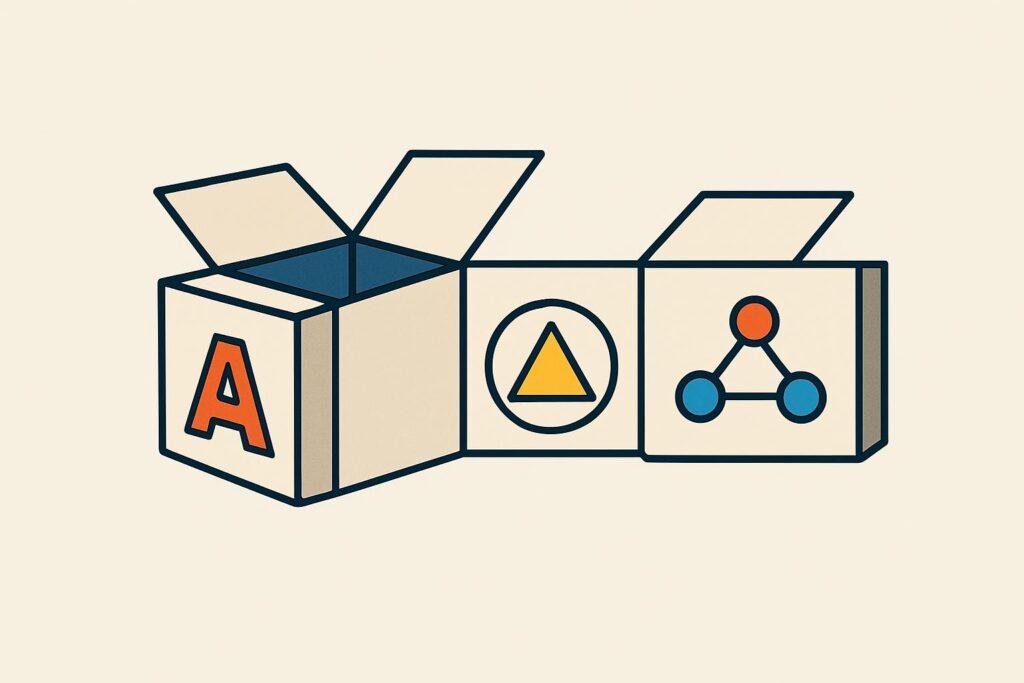
What does GPT stand for? Generative Pre-trained Transformer: a model that generates text, was trained in advance and runs on the transformer architecture. The abbreviation describes three things at once: what the model produces, when it acquired its knowledge of language, and which technique it runs on.
Those three words are not marketing terms. Each one explains a property you see in practice, from why the model always produces an answer to why that answer is not always correct.
The abbreviation also comes with a number of misconceptions. GPT is not the same as ChatGPT, the GPT series is one family of models from one provider, and competitors such as Claude and Gemini are not called GPT even though they run on similar technology.
Towards the end of this article, you will find what the abbreviation tells you about the reliability of the output, and why that knowledge changes your work in practical ways.
What does GPT stand for, word by word?
The three words in GPT are generative, pre-trained and transformer. Together, they describe a language model that produces text itself, that acquired its knowledge in advance, and that is built on a specific network architecture.
The order of the words is not random. Generative says what the model delivers, pre-trained says how it gets its capability, and transformer says what it uses to do so. Each word is explained separately below.
One misconception to clear up first: outside the AI context, GPT means something else. In computing, GPT stands for GUID Partition Table, the partitioning scheme for a hard drive that replaced the older MBR layout. The two abbreviations have nothing to do with each other; the context of the question determines which one is meant.
What does generative mean in GPT?
Generative means that a GPT model composes new text instead of retrieving existing answers. A traditional chatbot picked an answer from a fixed list; a generative model composes every answer from scratch, word by word.
That is why you rarely get exactly the same wording twice for the same question. The downside is that the model always produces something, even when the topic falls outside its training data. GPT shares this property with all other forms of generative AI, including image and audio models.
What does pre-trained mean in GPT?
Pre-trained means that a GPT model has acquired its knowledge of language before you use it. The training happens once on large amounts of text, after which the model carries that knowledge into every conversation.
That one-off training has a consequence most explanations skip: the model’s knowledge has a cut-off date. Anything that happened after the training is not in it, unless the model searches the web during the conversation or you supply the information yourself.
A second consequence is that the model retains nothing from the way you use it, unless a memory feature explicitly takes care of that. The training is separate from the conversation.
What does transformer mean in GPT?
Transformer is the architecture every GPT model runs on. The technique was described in 2017 by Google researchers in the paper Attention Is All You Need, and OpenAI built the first GPT model on it in 2018.
What sets a transformer apart is that it weighs all the words in a text at the same time instead of going through them one by one. This lets the model connect words that are far apart, which makes long texts and complex instructions manageable.
The architecture itself is not owned by OpenAI and underlies almost every modern large language model (LLM).
What is the difference between GPT and ChatGPT?
GPT is the language model; ChatGPT is the application built around it. The word Chat refers to the conversational interface OpenAI built on top of the model, with conversation history, file handling, memory and web access.
The distinction matters in practice, because the same GPT model also runs outside ChatGPT. Developers use it through an API, Microsoft resells it in its own software, and thousands of third-party applications run on it with a different layer around it.
So when people say ChatGPT, they mean the product.
If you want to learn to use the tool in a structured way rather than through one-off questions, the ChatGPT Course covers that approach step by step.
Which GPT models are there?
OpenAI’s GPT models run from GPT-1 in 2018 to the GPT-6 generation of 2026. In between came GPT-2 (2019), GPT-3 (2020), GPT-3.5, GPT-4 (2023), GPT-4o (2024) and the GPT-5 series, which ran from 2025 up to and including GPT-5.6 in 2026.
Since GPT-5.6, models within one generation also get their own name. The GPT-6 generation started with three models: GPT-6 Astra, announced on 3 September 2026 as the most capable model, and GPT-6 Sol and GPT-6 Luna, which OpenAI released on 22 September 2026 as faster and cheaper versions. On 29 September 2026, GPT-6.1 Sol followed as the successor to GPT-6 Sol, in the API and in ChatGPT Work and Codex. In the regular chat, GPT-6 Sol has been the default model on the paid plans since 7 October 2026, and GPT-6 Luna on Free and Go. Since 26 October 2026, there has also been GPT-6.1 Terra, in the API, Work and Codex. Sol is intended for complex programming and knowledge work, Luna for fast everyday work at scale.
Every version carries the same three properties from the abbreviation and differs in scale, speed, price and additional capabilities such as image and audio processing. The number tells you the generation; the name tells you its position within that generation.
Besides the GPT series, OpenAI also releases models under other names, such as the open-weight gpt-oss models. The video generator Sora has been discontinued, with the web and app versions closing on 26 April 2026 and the Sora API on 24 September 2026.
Are Claude and Gemini GPT models too?
Claude and Gemini are not GPT models, because GPT is the name OpenAI gives its own series of models. The term is a brand name, not a generic term, even though it is often used as one in practice.
Technically, the models are closer than the names suggest. Anthropic’s Claude and Google’s Gemini are both generative, both pre-trained and both built on the transformer architecture. The three words of the abbreviation apply to them just as well.
The difference lies in each provider’s training data, fine-tuning and safety measures, and you can see that in the output.
What does the abbreviation say about GPT’s reliability?
The abbreviation GPT explains why the output sounds convincing and can still be wrong. A generative model composes the next word based on probability, not on a fact check, so a fluent sentence is no proof of accuracy.
Pre-trained adds a second limitation. The model draws on patterns in its training data, and a plausible-looking pattern comes out with the same confidence as a correct fact.
A recurring pattern I saw with ChatGPT illustrates exactly that: when I entered a keyword, the model added a search volume without being asked, even though it has no connection to a keyword tool. The figure looked professional and was made up.
That phenomenon is called AI hallucination, and the abbreviation shows that it is not a defect but a direct consequence of how the technology works.
Frequently asked questions about GPT
The abbreviation GPT appears in other OpenAI product names, and those variants raise questions of their own.
What does the o in GPT-4o stand for?
The o in GPT-4o stands for omni, as OpenAI itself explained when it announced the model on 13 May 2024. OpenAI described the model as a step towards more natural interaction between people and computers. So the letter is not a version number but a label within the GPT-4 generation. The three words behind GPT apply to GPT-4o just as much as to the other models in the series.
What are GPTs in ChatGPT?
GPTs in ChatGPT are custom versions of ChatGPT with their own instructions and knowledge files, and they have little to do with the abbreviation itself. According to its help centre, OpenAI will stop supporting these custom GPTs on 11 December 2026 and is letting creators convert them into plugins, in which the instructions become a skill. Existing conversations with a GPT remain available after that date.
Is there a GPT model you can download yourself?
Yes, with gpt-oss, OpenAI has released GPT models whose weights you can download and run yourself. The two models, gpt-oss-120b and gpt-oss-20b, came out on 5 August 2025 under the Apache 2.0 licence. According to OpenAI, gpt-oss-120b fits on a single GPU with 80 GB of memory, while gpt-oss-20b runs with 16 GB. You cannot download the models behind ChatGPT itself.
Why is it useful to know what GPT stands for?
Knowing what GPT stands for changes three things in your daily work, and none of them is theoretical. The first is your expectation: generative means you always get an answer, so the question is not whether the model responds but whether the response is correct.
The second is your checking step. Pre-trained means a cut-off date and pattern-based output, so figures, sources and current facts always need checking before they end up anywhere.
The third is your instruction. A transformer takes the whole context into account, so the quality of your answer depends on the background, role and examples you provide.
Generative, pre-trained and transformer are therefore not three technical terms to memorise, but three reasons to adjust the way you work. LearnLLM’s ChatGPT Course covers that way of working at your own pace, with a certificate on completion.