What is OpenAI? OpenAI is an American AI company that makes language models, consumer products and software for developers, and it is best known as the maker of ChatGPT. The company was founded in December 2015 and its mission is to ensure that artificial general intelligence benefits all of humanity.
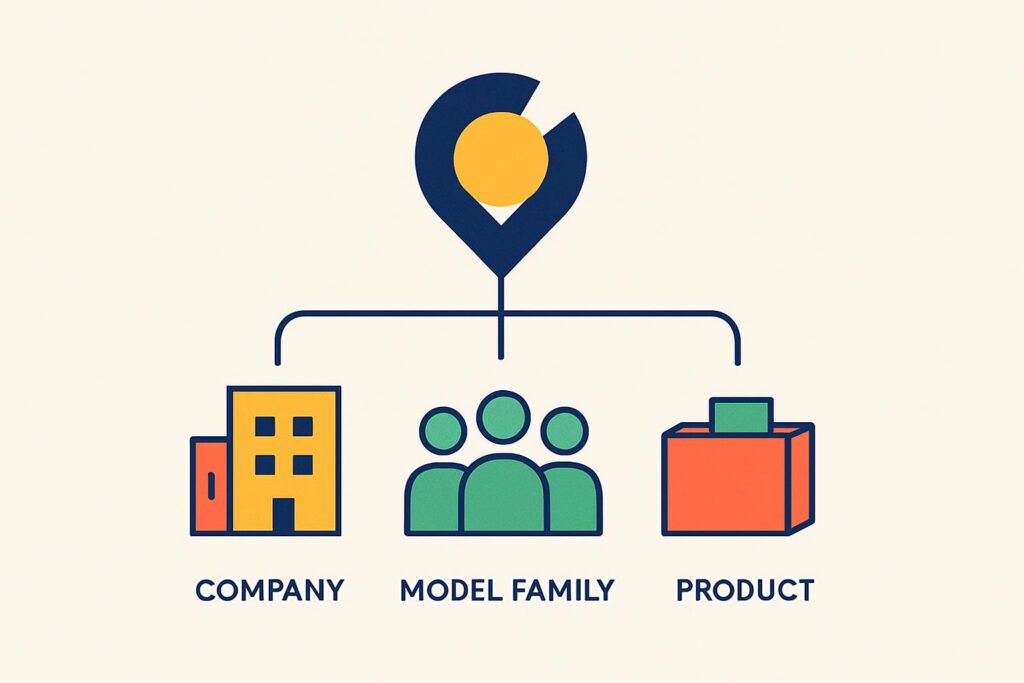
The distinction between the company and the product causes the most confusion. OpenAI is the organisation behind the GPT model family, and ChatGPT is the product in which you use those models. Besides ChatGPT, OpenAI provides an API for developers and a range of openly available models. You create images with ChatGPT Images; the video tool Sora was shut down completely on 24 September 2026.
The organisational structure is unusual for a technology company of this size. A non-profit foundation controls a commercial company, Microsoft is the largest outside shareholder, and revenue comes from subscriptions, API usage and business contracts.
For professional use, three questions matter more than the company’s history: what happens to your data, what alternatives exist, and how dependent you become on a single supplier. All three are covered at the end of this article.
What does OpenAI do as a company?
OpenAI develops AI models and sells access to them, and its business has four layers. The first layer is research into language models, reasoning and safety. The second layer is the models themselves, including the GPT family.
The third layer consists of consumer products, with ChatGPT as the best-known example. The fourth layer is the platform for businesses and developers, who build the models into their own software through an API.
Those four layers make OpenAI one of the few players that controls the entire chain. The company also invests in computing power, data centres and its own chip design, because the availability of computing power determines how many users it can handle and what an answer costs.
The technology OpenAI became known for falls under generative AI, the category of models that produce text, images or sound themselves instead of classifying existing data.
What is OpenAI’s mission?
OpenAI’s mission is to ensure that artificial general intelligence benefits all of humanity. Artificial general intelligence, abbreviated to AGI, is the term for a system that matches or exceeds human performance at almost every economically valuable task.
According to the charter OpenAI publishes itself, that mission rests on four principles: broadly distributing the benefits, safeguarding long-term safety, leading on technology and cooperating with other research institutions.
There is tension between that mission and day-to-day practice, and it is fair to point it out. An organisation that raises billions in capital faces investor expectations that do not automatically coincide with a public mission. The boardroom crisis of November 2023, in which the board fired the chief executive and he returned a week later, made that tension visible.
Who founded OpenAI?
OpenAI was founded in December 2015 by a group that included Sam Altman, Elon Musk, Greg Brockman and Ilya Sutskever. The founders and several investors jointly pledged 1 billion dollars. Musk left the board in 2018 and later founded the rival xAI.
Sam Altman has been the face of the company since its founding and serves as CEO. Greg Brockman is president.
What products does OpenAI make?
OpenAI has five product lines. ChatGPT is the chat interface for end users. The GPT models are the model family underneath. The newest generation is GPT-6: GPT-6 Astra was announced on 3 September 2026 as the most capable model, and GPT-6 Sol and GPT-6 Luna followed on 22 September 2026 as faster and cheaper variants. GPT-6.1 Sol, an improved version of Sol, came out on 29 September 2026, followed on 26 October 2026 by GPT-6.1 Terra, a fast model for ChatGPT Work and Codex.
The API is the platform developers use to build the models into their own software. Codex is the product line for software development. The video tool Sora has been discontinued, with the app and web version closing on 26 April 2026 and the API on 24 September 2026. The open-weight models gpt-oss-120b and gpt-oss-20b are released under the Apache 2.0 licence and run on your own hardware.
That last category is the exception to the rule. OpenAI’s commercial models are closed: the weights and training data are not published, despite the company’s name.
Is ChatGPT the same as GPT?
No, ChatGPT is OpenAI’s product and GPT is the model family that runs underneath it. The name GPT stands for Generative Pre-trained Transformer and refers to the model architecture, not to the chat environment in which you use it.
In practice, you notice the difference as soon as you look beyond the chat window. The same GPT model also runs in Microsoft software, in thousands of third-party applications and in companies’ custom solutions, each time with a different wrapper around it.
In the period when I used ChatGPT intensively, I built several custom GPTs for my SEO work, including ones for search intent classification and cannibalisation detection. Those GPTs taught me that the model is one component and that the instructions around it determine at least as much of the result.
What does the OpenAI API do for developers?
The OpenAI API gives developers direct access to the models, without the chat interface in between. You pay per processed token, the unit into which models split text, and you take care of error handling and cost monitoring yourself. When GPT-6 Sol was introduced, OpenAI halved the API price compared with the promotional price of GPT-5.6 Sol, to $2 input and $10 output per million tokens. GPT-6 Luna costs $0.10 input and $0.50 output, against $0.20 and $1.20 for GPT-5.6 Luna; OpenAI shows these prices in dollars.
Anyone moving from individual prompts to an API usually underestimates three things: the cost of testing, the inconsistency of output for identical input, and the difference between a prompt in the interface and the same prompt through the API. I ran into all three pitfalls myself when building workflows on an LLM API.
The API is therefore a different discipline from using ChatGPT. For teams that use ChatGPT for business without programming, the interface remains the logical route.
How is OpenAI organised?
Since 28 October 2025, OpenAI has consisted of two entities. The OpenAI Foundation is the non-profit foundation. OpenAI Group PBC is the commercial company, set up as a public benefit corporation: a legal form in which a public purpose is written into the articles alongside the profit motive.
The foundation controls the company through special governance rights. That structure has to reconcile two things that normally clash: raising billions in capital, and keeping control with a party that does not have to deliver a return.
Who owns OpenAI?
Since the restructuring of October 2025, OpenAI has been owned by three groups. The OpenAI Foundation holds 26 percent, Microsoft about 27 percent, and employees and investors the remaining 47 percent.
Ownership and control therefore diverge here. The largest shareholder is not the party that governs the organisation, because control lies in the foundation’s governance rights and not in the shareholding.
What role does Microsoft play at OpenAI?
Microsoft is OpenAI’s largest outside shareholder and at the same time its cloud provider, licence holder, customer and competitor. According to the joint announcement of 28 October 2025, Microsoft’s licence to the models and products runs until 2032.
That dual role deserves attention when you choose a supplier. Microsoft resells the OpenAI models in its own products, so you can buy the same technology through two parties on different terms.
How does OpenAI make money?
OpenAI earns revenue from four sources. Individuals and professionals pay a monthly subscription for more extensive access to ChatGPT. Developers pay per token the API processes.
Organisations sign business contracts with additional agreements on management, security and data processing. In February 2026, the company also started testing ads in the free version and the entry-level plan. Since late August 2026, those ads have also appeared in the Netherlands, on Free and Go only; Plus, Pro and Enterprise remain ad-free.
Revenue figures circulate widely but are rarely verified, so they are left out here.
What does OpenAI do with your data?
What OpenAI does with your data depends on the account type. On a free or paid consumer account, conversations may be used to improve models, unless you switch this off in your account’s data settings. On business plans and the API, that does not happen by default.
That distinction is the core of any AI policy within an organisation. An employee who pastes a client file into a private account is doing something different from the same action in a business environment, even though the screen looks identical.
From my years at major banks, I bring the four-eyes principle to my AI work, and here it translates simply: decide in advance which data may go into which account, and have someone else check it.
Who are OpenAI’s competitors?
OpenAI’s main competitors are Anthropic, Google, Meta and Mistral AI. Anthropic makes Claude and puts the emphasis on safety and reliability, which gives it a strong position in business writing and programming.
Google builds Gemini and has the advantage of existing distribution through Search, Android and Workspace. Meta released the open Llama models for years, but switched in April 2026 to the closed model Muse Spark, with an open-weight version, Muse Spark Open, since 15 October 2026. Mistral AI is the French provider and Europe’s answer to American dominance, relevant for organisations that want to keep data processing within the EU.
Which provider fits best depends on the task, not on the benchmark score.
Frequently asked questions about OpenAI
With OpenAI as a company, the practical questions often concern where it is based and whom to contact about your data.
Where is OpenAI based?
OpenAI is based in San Francisco, where OpenAI, L.L.C. has its address according to its own privacy policy. According to its careers page, the company has European offices in Dublin, London, Paris, Munich, Madrid and Stockholm, among others. Outside Europe, the same page lists New York, Tokyo, Singapore and Sydney, among others, as work locations.
Which OpenAI company is responsible for your data in the EU?
For users in the Netherlands and the rest of the European Economic Area, OpenAI Ireland Limited in Dublin is responsible for your data. OpenAI’s European privacy policy names that Irish entity as the controller of your personal data. For questions about that processing, you can contact OpenAI’s data protection officer, whose contact address is in the same privacy policy.
How do you contact OpenAI?
You contact OpenAI through the Help Center, where you start a chat with the support team. If you are logged in, click the Help button to start a conversation. Without an account, or if you cannot log in, use the chat icon at the bottom right of the Help Center page.
What does OpenAI mean for your work?
OpenAI affects your work in three ways, and none of them is about the company’s history. The first is the distinction between the company, the model family and the product: if you keep those apart, you choose more deliberately between ChatGPT, the API and a resold variant such as Copilot.
The second point is data. The account type determines whether conversations end up in training, and that choice should be recorded before a team uses the tool, not afterwards.
The third point is dependency. One supplier for all your AI work means that a price change, a model update or an outage lands directly in your process. Organisations that set a policy on this are also ahead on the obligations around AI Act compliance, including the duty to take measures that support employees’ AI literacy.
If you want to take ChatGPT further than asking one-off questions, start with a way of working rather than a tool. LearnLLM’s online ChatGPT Course covers that approach at your own pace, with a certificate on completion.