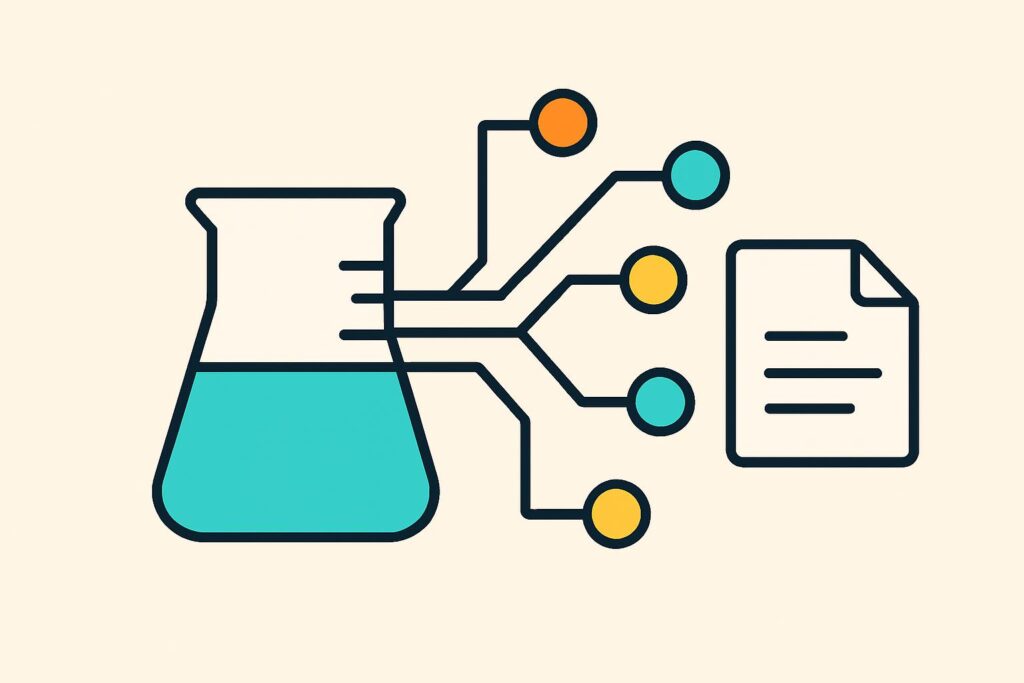
Claude Science is an AI workbench from Anthropic for scientific research, launched on 30 June 2026. The app combines databases, code execution and computing power in one working environment for researchers in fields such as genomics, proteomics and cheminformatics. It is not a new language model but a layer around the existing Claude models. For most professionals outside science, nothing changes in their own use of Claude.
What is Claude Science?
Claude Science is a desktop app that lets researchers carry out scientific work in one environment, from literature analysis to code execution and generating publication-ready figures. Anthropic stresses that it is not a new model, nor a stronger version of Claude for biology. The app runs on the same Claude models and safeguards as your subscription, including Claude Opus 5.5 (since 22 September 2026). According to Anthropic, a different Claude model can handle some sensitive requests in the life sciences, and screened research organisations get wider access through trusted access programmes.
The app builds on Claude for Life Sciences, which Anthropic released in October 2025 as a set of plug-ins for scientific software and databases. Claude Science takes that a step further into a dedicated working environment, available in beta for macOS, Windows and Linux, and open to Pro, Max, Ultra, Team and Enterprise subscribers.
How does Claude Science work?
Claude Science works with a coordinating agent that takes your research question in plain language and determines which specialised tools are needed. That agent has access to more than sixty curated skills and connectors, preconfigured for genomics, single-cell analysis, proteomics, structural biology and cheminformatics.
The coordinating agent can call in specialist subagents itself, or work with agents the user has built previously.
A reviewer agent runs in parallel and checks whether citations, calculations and figures can actually be traced back to the underlying data and code. That is a direct response to a well-known problem: AI-generated text that sounds convincing but is factually wrong.
What features does Claude Science have?
The most important feature of Claude Science is reproducibility. Every figure or table the app produces comes with the exact code and environment used to create it, a plain-language description and the full conversation history. Months later, another researcher can retrace exactly the same steps.
When it comes to computing power, Claude Science manages the compute jobs for you. The app runs locally on a laptop or Linux machine and can send a job via SSH to an HPC cluster with Slurm, or use on-demand computing power via Modal. Large datasets stay on your own infrastructure; only the context a step needs goes to Claude.
Claude Science is set up for specific fields from the start. The app connects to more than sixty scientific databases, including UniProt, PDB and ClinVar, and integrates with NVIDIA’s BioNeMo Agent Toolkit for models such as Evo 2, Boltz-2 and OpenFold3. That makes the app immediately usable for protein folding, genome analysis and similar tasks without a lab having to build integrations itself.
Who is Claude Science for?
Claude Science is intended for researchers and scientific labs, with a focus on the life sciences: biomedical research, chemistry and related hard sciences. Academic institutions and non-profit research organisations are eligible for a discounted Team plan, verified via the lab’s principal investigator. Commercial parties, such as contract research organisations, fall under the regular Team and Enterprise plans.
On a Team or Enterprise plan, an administrator must first enable Claude Science for the organisation before team members can use the app, except on the Claude Team plan for Scientists, where the app is switched on by default.
Anthropic is also supporting up to fifty Claude Science projects with a budget of up to 30,000 dollars per project, aimed at PhD students and researchers working across disciplines within biomedical research. Applications closed on 15 July 2026; awards were scheduled for the end of July and the projects run from September to December 2026.
Early users mainly focus on specific research tasks: a neuroscientist at the Allen Institute used Claude Science to build a multi-agent pipeline for computational review, and a research group at UCSF used the app to speed up a germline analysis of glioma data. That fits the picture Anthropic itself paints: a tool for specific, code-driven analyses, not a general assistant.
If you work outside science, in marketing, financial advice or legal services for example, Claude Science adds little. It is not a productivity app for text, spreadsheets or client work but a specialised research environment.
How do you combine Claude Science with other Claude tools?
You combine Claude Science with other Claude tools by looking at what each tool solves: Claude Science is for research, not for software development or collaborating on documents. For programming work, Claude Code remains the tool of choice, with the same underlying logic of agents and skills but aimed at codebases instead of lab data.
For teamwork outside a purely scientific context, Claude Cowork is a better fit. It has been merging in phases into the ordinary chat for Pro and Max since 16 September 2026 and is built for collaboration on broader office tasks, not for genomics pipelines.
The pattern behind all these tools is the same: a coordinating agent that deploys specialist skills for a specific context. Claude Science is the scientific version of that pattern, not a separate product with its own logic.
Frequently asked questions about Claude Science
If you are considering Claude Science for a lab or research group, practical questions about usage and scope will soon come up.
Does Claude Science count towards your plan’s usage limits?
Yes, use of Claude Science counts towards the same usage limits as the rest of your Claude subscription, including Claude Code and Cowork. There is nothing extra to buy, but the app is not available on the Free plan. Under Settings and Usage you can see how much you have used and when a limit resets. If you reach a limit, the session pauses and your conversation and results are kept.
Is Claude Science only for the life sciences?
No, Claude Science is not limited to the life sciences, even though researchers in biology and chemistry get most of the specialised integrations. According to Anthropic’s documentation, the app also supports computer science and machine learning, engineering, materials science, mathematics, physics and the social sciences. For those fields you add data sources and methods yourself via your own connectors and skills.
Which programming languages does Claude Science use?
Claude Science writes and runs code in Python, R and shell, in an isolated sandbox on your own computer. The app can read, run and extend existing workflows in those languages, and installs the packages an analysis needs on its own. You first grant permission for each folder, network address and external compute job before Claude may use it.
Can you use Claude Science for clinical or diagnostic decisions?
No, according to Anthropic, Claude Science is a research tool and not intended for clinical or diagnostic use. The built-in reviewer reduces the number of errors, but it only checks claims against the execution log and does not rerun analyses. Anthropic therefore advises verifying results yourself before using them in research, a publication or follow-up decisions.
How do you learn to work with Claude yourself?
Claude Science is reserved for researchers, but you can learn the skills to work well with Claude in your own field separately from this specific product. Claude is my primary everyday tool, both through the interface and through the API, and I translate that practical experience into the way the Claude Course is built.
The course does not cover scientific workbenches such as Claude Science, but it does cover the basic skills that help you in any field: how to build prompts, how to have Claude process documents, and how to use Claude in a repeatable way of working instead of one-off attempts.